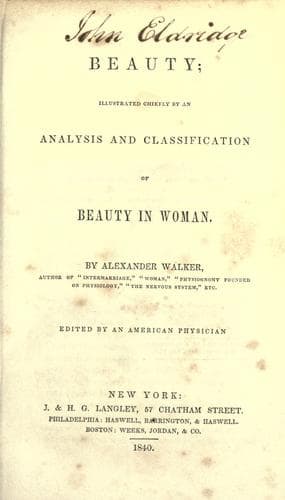
Beauty: Illustrated Chiefly by an Analysis and Classification of Beauty in WomanWalker, Alexander
Philosophy
Beauty: Illustrated Chiefly by an Analysis and Classification of Beauty in Woman
Walker, Alexander
Beauty, Personal; Women
"Since the imagination is only the representation of the senses, it can
only be pleased or displeased with the images, from the same principle on
which the sense is pleased or displeased with the realities; and
consequently there must be just as close an agreement in the imaginations
as in the senses of men.
"There are some men formed with feelings so blunt, with tempers so cold
and phlegmatic, that they can hardly be said to be awake during the whole
course of their lives. Upon such persons, the most striking objects make
but a faint and obscure impression. There are others so continually in the
agitation of gross and merely sensual pleasures, or so occupied in the low
drudgery of avarice, or so heated in the chase of honors and distinction,
that their minds, which had been used continually to the storms of these
violent and tempestuous passions, can hardly be put in motion by the
delicate and refined play of the imagination. These men, though from a
different cause, become as stupid and insensible as the former; but
whenever either of these happen to be struck with any natural elegance or
greatness, or with these qualities in any work of art, they are moved upon
the same principle."
On a third point, Hume says: "But though there be naturally a wide
difference in point of delicacy between one person and another, nothing
tends farther to increase and improve this talent, than _practice_ in a
particular art, and the frequent survey or contemplation of a particular
species of beauty.
"So advantageous is practice to the discernment of beauty, that, before we
can give judgment on any work of importance, it will even be requisite
that that very individual performance be more than once perused by us, and
be surveyed in different lights with attention and deliberation."
This is well illustrated by Burke, who observes: "It is known that the
taste (whatever it is) is improved exactly as we improve our knowledge, by
a steady attention to our object, and by frequent exercise.
"To illustrate this--(that there is a difference, not in the causes, nor
in the manner of men's being affected, but in the degree, owing to natural
sensibility, or greater attention to the object)--to illustrate this by
the procedure of the senses in which the same difference is found, let us
suppose a very smooth marble-table to be set before two men; they both
perceive it to be smooth, and they are both pleased with it because of
this quality. So far they agree.
"But suppose another, and after that another table, the latter still
smoother than the former, to be set before them. It is now very probable
that these men, who are so agreed upon what is smooth, and in the pleasure
thence, will disagree when they come to settle which table has the
advantage in point of polish.... Nor is it easy, when such a difference
arises, to settle the point, if the excess or diminution be not glaring.
Public-domain text, read in full here on John Shaqi.
Reviews
Reviews
No reviews yet
Be the first to share your thoughts on this work.
Join the Discussion
Join the discussion
Sign in to leave a comment or review.
Sign InorCreate an account