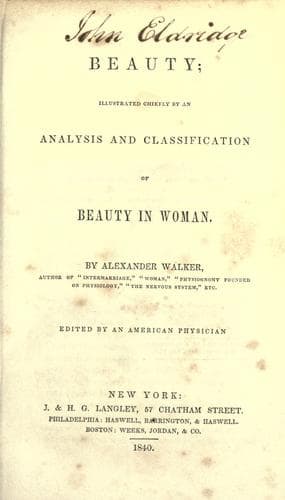
Beauty: Illustrated Chiefly by an Analysis and Classification of Beauty in WomanWalker, Alexander
Philosophy
Beauty: Illustrated Chiefly by an Analysis and Classification of Beauty in Woman
Walker, Alexander
Beauty, Personal; Women
Taking the principal ideas above, Burke also concludes: "On the whole it
appears to me, that what is called taste, in its most general acceptation,
is not a simple idea, but is partly made up of a perception of the primary
pleasures of sense, of the secondary pleasures of the imagination, and of
the conclusions of the reasoning faculty, concerning the various relations
of these, and concerning the human passions, manners, and actions."
"It is sufficient for our present purpose," Hume farther observes, "if we
have proved that the taste of all individuals is not upon an equal
footing, and that some men in general, however difficult to be
particularly pitched upon, will be acknowledged by universal sentiment to
have a preference above others.
"Though men of delicate taste be rare, they are easily to be distinguished
in society by the soundness of their understanding, and the superiority of
their faculties above the rest of mankind. The ascendant which they
acquire, gives a prevalence to that lively approbation, with which they
receive any productions of genius, and renders it generally predominant.
Many men, when left to themselves, have but a faint and dubious perception
of beauty, who yet are capable of relishing any fine stroke which is
pointed out to them. Every convert to the admiration of the real poet or
orator, is the cause of some new conversion. And though prejudices may
prevail for a time, they never unite in celebrating any rival to the true
genius, but yield at last to the force of nature and just sentiment."
Hume finally obviates some apparent difficulties:--
"But notwithstanding all our endeavors to fix a standard of taste, and
reconcile the discordant apprehensions of men, there still remain two
sources of variation, which are not sufficient indeed to confound all the
boundaries of beauty and deformity, but will often serve to produce a
difference in the degrees of our approbation or blame. The one is the
different humors of particular men; the other, the particular manner and
opinions of our age and country.
"A young man, whose passions are warm, will be more sensibly touched with
amorous and tender images, than a man more advanced in years, who takes
pleasure in wise, philosophical reflections concerning the conduct of life
and moderation of the passions. At twenty, Ovid may be the favorite
author; Horace at forty; and perhaps Tacitus at fifty. Vainly would we, in
such cases, endeavor to enter into the sentiments of others, and divest
ourselves of those propensities which are natural to us. We choose our
favorite author as we do our friend, from a conformity of humor and
disposition.
"Such preferences are innocent and unavoidable, and can never reasonably
be the object of dispute, because there is no standard by which they can
be decided.
Public-domain text, read in full here on John Shaqi.
Reviews
Reviews
No reviews yet
Be the first to share your thoughts on this work.
Join the Discussion
Join the discussion
Sign in to leave a comment or review.
Sign InorCreate an account