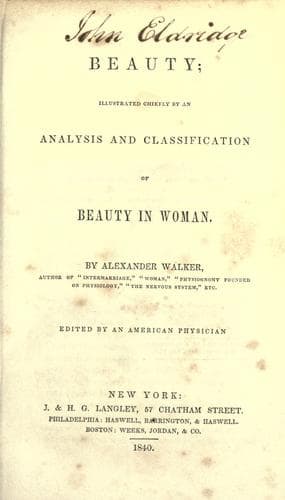
Beauty: Illustrated Chiefly by an Analysis and Classification of Beauty in WomanWalker, Alexander
Philosophy
Beauty: Illustrated Chiefly by an Analysis and Classification of Beauty in Woman
Walker, Alexander
Beauty, Personal; Women
"In the morning of our days, when the senses are unworn and tender, when
the whole man is awake in every part, and the gloss of novelty fresh upon
all the objects that surround us, how lively at that time are our
sensations, but how false and inaccurate the judgments we form of things!
"Every trivial cause of pleasure is apt to affect the man of too sanguine
a complexion: his appetite is to keen to suffer his taste to be
delicate.... One of this character can never be a refined judge; never
what the comic poet calls '_elegans formarum spectator_.'
"The rude hearer is affected by the principles which operate in these arts
even in their rudest condition; and he is not skilful enough to perceive
the defects. But as arts advance toward their perfection, the science of
criticism advances with equal pace, and the pleasure of judges is
frequently interrupted by the faults which are discovered in the most
finished compositions."
The chief idea above expressed, is again repeated by Sir J. Reynolds, who
says: "The principles of these (the imagination and the passions) are as
invariable as the former (the senses), and are to be known and reasoned
upon in the same manner, by an appeal to _common sense_ deciding upon the
common feelings of mankind."
These views are thus summed by Hume: "The organs of internal sensation are
seldom so perfect as to allow the general principles their full play, and
produce a feeling correspondent to those principles. They either labor
under some defect, or are vitiated by some disorder; and by that means,
excite a sentiment, which may be pronounced erroneous. When the critic has
no delicacy, he judges without any distinction, and is only affected by
the grosser and more palpable qualities of the object: the finer touches
pass unnoticed and disregarded. Where he is not aided by practice, his
verdict is attended with confusion and hesitation. Where no comparison has
been employed, the most frivolous beauties, such as rather merit the name
of defects, are the object of his admiration. Where he lies under the
influence of prejudice, all his natural sentiments are perverted. Where
good sense is wanting, he is not qualified to discern the beauties of
design and reasoning, which are the highest and most excellent. Under some
or other of these imperfections, the generality of men labor; and hence, a
true judge in the finer arts is observed, even during the most polished
ages, to be so rare a character: strong sense, united to delicate
sentiment, improved by practice, perfected by comparison, and cleared of
all prejudice, can alone entitle critics to this valuable character; and
the joint verdict of such, wherever they are to be found, is the true
standard of taste and beauty."
Public-domain text, read in full here on John Shaqi.
Reviews
Reviews
No reviews yet
Be the first to share your thoughts on this work.
Join the Discussion
Join the discussion
Sign in to leave a comment or review.
Sign InorCreate an account