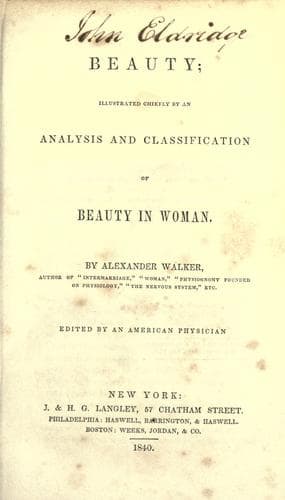
Beauty: Illustrated Chiefly by an Analysis and Classification of Beauty in WomanWalker, Alexander
Philosophy
Beauty: Illustrated Chiefly by an Analysis and Classification of Beauty in Woman
Walker, Alexander
Beauty, Personal; Women
Again, I repeat, it is to this analysis and generalization alone, and to
the systemization founded upon it, that I make any pretence. The materials
have long been presented by all the great writers on the subject: they
have only left them in confusion, and without conclusion. I shall now
proceed to employ them.
SECTION I.
ELEMENTS OF BEAUTY IN INANIMATE BEINGS.
Though Burke did not accurately trace the elements of beauty in any one
class of the objects of nature or art, he yet states a preliminary truth
on this subject so well, that I here quote it: "It would be absurd," he
observes, "to say that all things affect us by association only; since
some things must have been originally and naturally agreeable or
disagreeable, from which the others derive their associated powers; and it
would be, I fancy, to little purpose to look for the cause of our passions
in association, until we fail of it in the natural properties of things."
Home, advancing farther, says: "If a tree be beautiful by means of its
color, its figure, its size, its motion, it is in reality possessed of so
many different beauties, which ought to be examined separately, in order
to have a clear notion of the whole.
"When any body is viewed as a whole, the beauty of its figure arises from
regularity[12] and simplicity; and viewing the parts with relation to each
other, from uniformity[12], proportion, and order."
I will here only observe that these are the qualities, as will speedily
appear, which Burke should have set down as the fundamental and first
characteristics of beauty, instead of relative littleness, which belongs
not to beauty generally, but only to the minor or subordinate beauty.
Even Home, having arrived thus far, says: "To inquire why an object, by
means of the particulars mentioned, appears beautiful, would, I am afraid,
be a vain attempt."
But he truly adds: "One thing is clear, that regularity, uniformity,
order, and simplicity, contribute each of them to readiness of
apprehension, and enable us to form more distinct images of objects than
can be done, with the utmost attention, where these particulars are not
found." And he subjoins: "This final cause is, I acknowledge, too slight,
to account satisfactorily for a taste that makes a figure so illustrious
in the nature of man; and that this branch of our constitution has a
purpose still more important, we have great reason to believe."
Now had Home seen that the characteristics of general beauty always are,
with regard to the object, accordant and agreeable relations, the
importance of the qualities he has just enumerated would have been
evident; for, without them, these characteristics of the object could not
exist: simplicity, regularity, uniformity, order, &c., are the very
elements of accordant and agreeable relations. This is in reality the
still more important purpose in which Home believed, and to which the
readiness of apprehension he now alludes to eminently contributes.
Public-domain text, read in full here on John Shaqi.
Reviews
Reviews
No reviews yet
Be the first to share your thoughts on this work.
Elsewhere in the archive
Join the Discussion
Join the discussion
Sign in to leave a comment or review.
Sign InorCreate an account