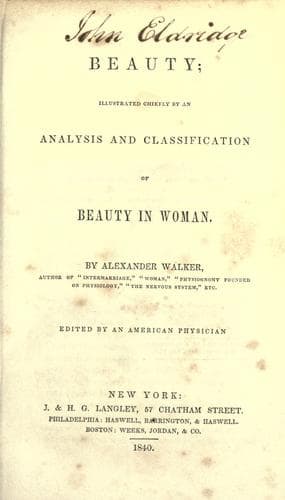
Beauty: Illustrated Chiefly by an Analysis and Classification of Beauty in WomanWalker, Alexander
Philosophy
Beauty: Illustrated Chiefly by an Analysis and Classification of Beauty in Woman
Walker, Alexander
Beauty, Personal; Women
As to simplicity, he observes, that "a multitude of objects crowding into
the mind at once, disturb the attention, and pass without making any
impression, or any lasting impression; and in a group, no single object
makes the figure it would do apart, when it occupies the whole attention.
For the same reason, even a single object, when it divides the attention
by the multiplicity of its parts, equals not, in strength of impression, a
more simple object comprehended in a single view: parts extremely complex
must be considered in portions successively; and a number of impressions
in succession, which cannot unite because not simultaneous, never touch
the mind like one entire impression made as it were at one stroke.
"A square is less beautiful than a circle, because it is less simple: a
circle has parts as well as a square; but its parts not being distinct
like those of a square, it makes one entire impression; whereas, the
attention is divided among the sides and angles of a square.... A square,
though not more regular than a hexagon or octagon, is more beautiful than
either, because a square is more simple, and the attention less divided.
"Simplicity thus contributes to beauty."
By regularity is meant that circumstance in a figure by which we perceive
it to be formed according to a certain rule. Thus, a circle, a square, a
parallelogram, or triangle, pleases by its regularity.
"A square," says Home--(who here furnishes the best materials to a more
general view, because he most frequently assigns physical causes, and
whom, with some abbreviation, I therefore continue to quote)--"a square is
more beautiful than a parallelogram, because the former exceeds the latter
in regularity and in uniformity of parts. This is true with respect to
intrinsic beauty only; for in many instances, utility comes in to cast the
balance on the side of the parallelogram: this figure for the doors and
windows of a dwelling-house, is preferred because of utility; and here we
find the beauty of utility prevailing over that of regularity and
uniformity."
Thus regularity and uniformity contribute to intrinsic beauty.
"A parallelogram, again, depends for its beauty on the proportion [or
relation of quantity] of its sides. Its beauty is lost by a great
inequality of these sides: it is also lost by their approximating toward
equality; for proportion there degenerates into imperfect uniformity, and
the figure appears an unsuccessful attempt toward a square."
Thus proportion contributes to beauty.
"An equilateral triangle yields not to a square in regularity nor in
uniformity of parts, and it is more simple. Its inferiority in beauty is
at least partly owing to inferiority of order in the position of its
parts: the sides of an equilateral triangle incline to each other in the
same angle, which is the most perfect order they are susceptible of; but
this order is obscure, and far from being so perfect as the parallelism of
the sides of a square."
Public-domain text, read in full here on John Shaqi.
Reviews
Reviews
No reviews yet
Be the first to share your thoughts on this work.
Elsewhere in the archive
Join the Discussion
Join the discussion
Sign in to leave a comment or review.
Sign InorCreate an account