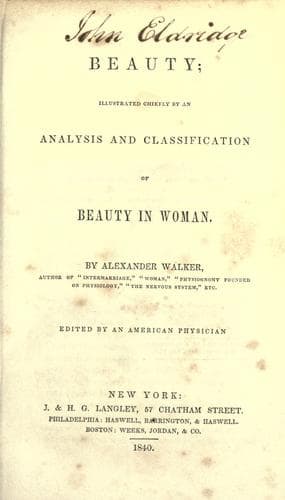
Beauty: Illustrated Chiefly by an Analysis and Classification of Beauty in WomanWalker, Alexander
Philosophy
Beauty: Illustrated Chiefly by an Analysis and Classification of Beauty in Woman
Walker, Alexander
Beauty, Personal; Women
If, to such a man, it should for a moment have appeared worth while to ask
why we do not make use of feeling-boards, as well as of smelling-bottles,
he ought to have sought the solution of his difficulty in the nature of
the senses; and then, with a trifle more of ability than Payne Knight
hereby shows himself to have possessed, he would have seen that smoothness
affords us as much pleasure as any smell, but that, as it would have been
always troublesome, and often impossible, to apply our fingers to smooth
surfaces, we generally receive the varied and incessant pleasure it
affords, by means of sight; that it is borne by light to the eye, as smell
is by the air; and that this is the reason why, except when contact is
indispensable, we have no need of anything in the way of a feeling-board.
But Knight says: "Smoothness being properly a quality, perceivable only by
the touch, and applied metaphorically to the objects of the other senses,
we often apply it, very improperly, to those of vision; assigning
smoothness as a cause of visible beauty, to things which, though smooth to
the touch, cast the most sharp, harsh, and angular reflections of light
upon the eyes; and these reflections are all that the eye feels, or
naturally perceives.... Such are all objects of cut-glass or polished
metal; as may be seen by the manner in which painters imitate them: for,
as the imitations of painting extend only to the visible qualities of
bodies, they show those visible qualities fairly and impartially.... Yet
the imitative representation of such objects in painting is far less harsh
and dazzling than the effects of them in reality: for there are no
materials that a painter can employ, capable of expressing the sharpness
and brilliancy of those angular reflections of the collected and
condensed rays, which are emitted from the surfaces of polished metals."
It seems, to me, scarcely possible to find sophistry more worthless than
this, or rather a more contemptible quibble; for that which, availing
himself of our technicalities about light, he calls angularity, sharpness,
&c., has no analogy with disagreeable angularity of form. To produce the
brilliance and splendor which he calls angular, and describes as so
_offensive_, we polish crystalline and metallic bodies in the highest
degree!--we value precisely those which thus admit of greatest
splendor!--and, on that very account, the diamond (rightly or wrongly, is
not the question) is deemed the most valuable object on earth!
So much for those elements of beauty, in inanimate things, which fall
under the cognizance of our fundamental sense, or that of touch.
As to sight and its objects, it is true that, as this organ varies in
different persons, their taste is modified, with regard to colors. But the
preference of light and delicate colors to dark and glaring ones, is
almost universal among persons of sensibility.
Public-domain text, read in full here on John Shaqi.
Reviews
Reviews
No reviews yet
Be the first to share your thoughts on this work.
Elsewhere in the archive
Join the Discussion
Join the discussion
Sign in to leave a comment or review.
Sign InorCreate an account