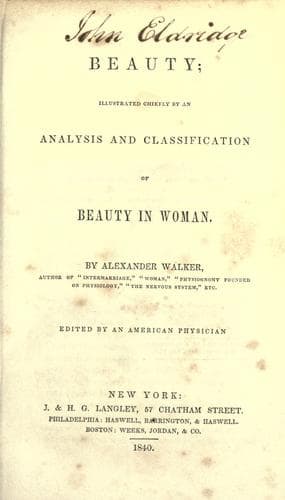
Beauty: Illustrated Chiefly by an Analysis and Classification of Beauty in WomanWalker, Alexander
Philosophy
Beauty: Illustrated Chiefly by an Analysis and Classification of Beauty in Woman
Walker, Alexander
Beauty, Personal; Women
Alison, indeed, ascribes the effects of all colors to association.
"White," he says, "as it is the color of day, is expressive to us of the
cheerfulness or gayety which the return of day brings: black, as the color
of darkness [night], is expressive of gloom and melancholy." And he adds:
"Whether some colors may not of themselves produce agreeable sensations,
and others disagreeable sensations, I am not anxious to dispute." But
this is the very point into which Alison ought to have inquired. Nature
does nothing without foundation in the simplest principles; and this
foundation is not only anterior to, but is the cause of all association.
That, independent of any association, blackness is naturally disagreeable,
if not painful, is happily determined by the case of the boy restored to
sight by Cheselden, who tells us that the first time the boy saw a black
object, it gave him great uneasiness; and that, some time after, upon
accidentally seeing a negro-woman, he was struck with great horror at the
sight. This appears to be perfectly conclusive.
Knight indeed says: "As to the uneasiness which the boy, couched by
Cheselden, felt at the first sight of a black object, it arose either from
the harshness of its outline, or from its appearing to act as a partial
extinguisher applied to his eyes, which, as every object that he saw,
seemed to touch them, would, of course, be its effect." It is highly
probable that black operates in both these ways; and it has therefore
natural effects, independent of all association.
As to sounds, Alison observes, that the cries of some animals are sublime,
as the roar of the lion, the scream of the eagle, &c.; and he thinks they
become so, because we associate them with the strength and ferocity of the
animals which utter them. By opposite associations, he accounts for the
beauty of the notes of birds. And he says, that there is a similar
sublimity or beauty, in the tones of the human voice, and that "such
sounds are associated, in our imaginations, with the qualities of mind of
which they are in general expressive, and naturally produce in us the
conception of these qualities."
Public-domain text, read in full here on John Shaqi.
Reviews
Reviews
No reviews yet
Be the first to share your thoughts on this work.
Elsewhere in the archive
Join the Discussion
Join the discussion
Sign in to leave a comment or review.
Sign InorCreate an account