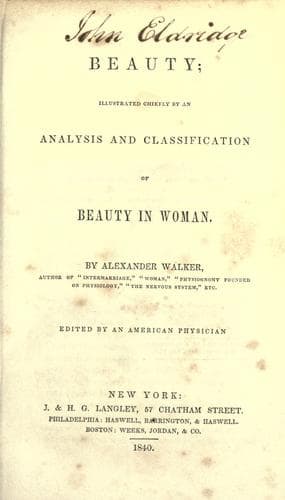
Beauty: Illustrated Chiefly by an Analysis and Classification of Beauty in WomanWalker, Alexander
Philosophy
Beauty: Illustrated Chiefly by an Analysis and Classification of Beauty in Woman
Walker, Alexander
Beauty, Personal; Women
In the locomotive functions, the bones at once give support, and form
levers for motion; the ligaments form articulations, and afford the points
of support; and the muscles are the moving powers. To the first, are owing
all the symmetry and elegance of human form; to the second, its beautiful
flexibility; and to the third, all the brilliance and grace of motion
which fancy can inspire, or skill can execute.
In the nutritive functions, the food, having passed into the mouth, is,
after mastication, aided by mixture with the saliva, thrown back, by the
tongue and contiguous parts, into the cavity behind, called fauces and
pharynx; this contracting, presses it into the oesophagus or gullet;
this also contracting, propels it into the stomach, which, after its due
digestion aided by the gastric juice, similarly contracting, transmits
whatever portion of it, now called chyme, is sufficiently comminuted to
pass through its lower opening, the pylorus, into the intestines; these,
at the commencement of which it receives the bile and pancreatic juice,
similarly pressing it on all sides, urge forward its most solid part to
the anus; while its liquid portion partly escapes from the pressure into
the mouths of the absorbents. The absorbents arising by minute openings
from all the internal surfaces, and continuing a similar contractile
motion, transmit it, now called chyle, by all their gradually-enlarging
branches, and through their general trunk, the thoracic duct, where it is
blended with the lymph brought from other parts, into the great veins
contiguous to the heart, where it is mixed with the venous or returning
and dark-colored blood, and whence it flows into the anterior side of that
organ. The anterior side of the heart, forcibly repeating this
contraction, propels it, commixed with the venous blood, into the lungs,
which perform the office of respiration, and in some measure of
sanguification; there, giving off carbonaceous matter, and assuming a
vermilion hue and new vivifying properties, it flows back as arterial
blood, into the posterior side of the heart. The posterior side of the
heart, still similarly contracting, discharges it into the arteries;
these, maintaining a like contraction, carry it over all the system; and a
great portion of it, impregnated with carbon, and of a dark color, returns
through the veins in order to undergo the same course. Much, however, of
its gelatinous and fibrous parts is retained in the cells of the
parenchyma, or cellular, vascular, and nervous substance forming the basis
of the whole fabric, and constitutes nutrition, properly so called; while
other portions of it become entangled in the peculiarly-formed labyrinths
of the glands, and form secretion and excretion--the products of the
former contributing to the exercise of other functions, and those of the
latter being rejected. As digestion precedes the first, so generation
follows the last of these functions, and not only continues the same
Public-domain text, read in full here on John Shaqi.
Reviews
Reviews
No reviews yet
Be the first to share your thoughts on this work.
Elsewhere in the archive
Join the Discussion
Join the discussion
Sign in to leave a comment or review.
Sign InorCreate an account