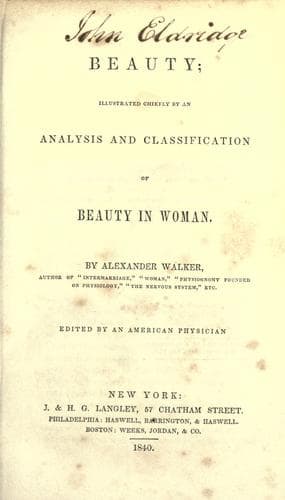
Beauty: Illustrated Chiefly by an Analysis and Classification of Beauty in WomanWalker, Alexander
Philosophy
Beauty: Illustrated Chiefly by an Analysis and Classification of Beauty in Woman
Walker, Alexander
Beauty, Personal; Women
It is, moreover, worthy of remark, and still illustrative of the preceding
arrangements, that, in each of these three situations, the bones differ
both in, position and in form. In the extremities, they are situated
internally to the soft parts, and are generally of cylindrical form; in
the trunk, they begin to assume a more external situation and a flatter
form, because they protect nutritive and more important parts, which they
do not, however, altogether cover; and, in the head, they obtain the most
external situation and the flattest form, especially in its highest part,
because they protect thinking and most important organs, which, in some
parts, they completely invest.
The loss of such general views is the consequence of arbitrary
methods.[30]
We may now apply these anatomical and physiological views to the art of
distinguishing and judging of beauty in woman.
It is evidently the locomotive or mechanical system which is highly
developed in the beauty whose figure is precise, striking, and brilliant.
It is evidently the nutritive or vital system which is highly developed in
the beauty whose figure is soft and voluptuous.
It is not less evidently the thinking or mental system which is highly
developed in the beauty whose figure is characterized by intellectuality
and grace.
Thus can anatomical principles alone at once illustrate and establish the
accuracy of the three species of beauty which I have analytically
described.
CHAPTER VIII.
OF THE AGES OF WOMAN IN RELATION TO BEAUTY.
The variations of the organization of woman do not distinctly mark the
seasons of life. Many connected phenomena glide on imperceptibly; and we
can distinguish the strong characters of different and distinct ages, only
at periods remote from each other. Although, therefore, woman is
perpetually changing, it requires some care to discriminate the principal
epochs of her life.
The first age of woman extends from birth to the period of puberty.
In beginning the career of life, woman is not yet truly woman; the
characters of her sex are not yet decided; she is an equivocal being, who
does not differ from the male of the same age even by the delicacy of the
organs; and we observe between them a perfect identity of wants,
functions, and movements. Their existence is, then, purely individual; we
perceive none of the relations which afterward establish between them a
mutual dependance; each lives only for self.
This conformity and independence of the sexes are the more remarkable, the
earlier the age and the less advanced the development.
Confining our view to woman alone, it is not only in dimensions that, at
this age, her person differs from that in which the growth is terminated:
it presents another model. The various parts have not, in relation to each
other, the same proportions.
Public-domain text, read in full here on John Shaqi.
Reviews
Reviews
No reviews yet
Be the first to share your thoughts on this work.
Elsewhere in the archive
Join the Discussion
Join the discussion
Sign in to leave a comment or review.
Sign InorCreate an account