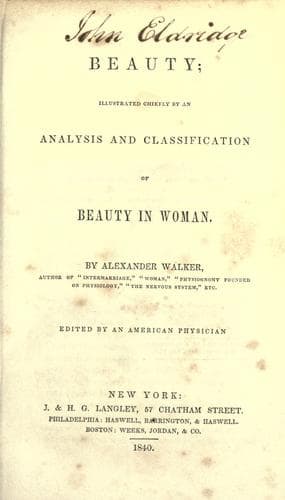
Beauty: Illustrated Chiefly by an Analysis and Classification of Beauty in WomanWalker, Alexander
Philosophy
Beauty: Illustrated Chiefly by an Analysis and Classification of Beauty in Woman
Walker, Alexander
Beauty, Personal; Women
If, however, during these states, suitable precautions and preservative
cares be not employed, it is the first class who most suffer from traces
of maternity.
Conception, pregnancy, delivery, and suckling, being renewed more or less
frequently during the second age, hasten debility in feeble and
ill-constituted women; especially if misery or an improper mode of life
increase the influence of these causes.
In the third age of woman, extending generally from forty to sixty, the
physical form does not suddenly deteriorate; and, as has often been
observed, "when premature infirmities or misfortunes, the exercise of an
unfavorable profession, or a wrong employment of life, have not hastened
old age, women during the third age preserve many of the charms of the
preceding one."
At this period, in well-constituted women, the fat, being absorbed with
less activity, is accumulated in the cellular tissue under the skin and
elsewhere; and this effaces any wrinkles which might have begun to furrow
the skin, rounds the outlines anew, and again restores an air of youth and
freshness. Hence, this period is called "the age of return."
This plumpness, though juvenile lightness and freshness be wanting,
sustains the forms, and sometimes confers a majestic air, which, in women
otherwise favorably organized, still interests for a number of years.
The shape certainly is no longer so elegant; the articulations have less
elasticity; the muscles are more feeble; the movements are less light; and
in plump women we observe those broken motions, and in meager ones that
stiffness, which mark the walk or the dance at that age.
At this period occurs a remarkable alteration in the organs of voice.
Women, therefore, to whom singing is a profession, ought to limit its
exercise.
When women pass happily from the third to the fourth age, their
constitution, as every one must have observed, changes entirely; it
becomes stronger: and nature abandons to individual life all the rest of
existence.
Beauty, however, is no more; form and shape have disappeared; the
plumpness which supported the reliefs has abandoned them; the sinkings and
wrinkles are multiplied; the skin has lost its polish; color and freshness
have fled for ever.
These injuries of time, it has been observed, commonly begin by the
abdomen, which loses its polish and its firmness; the hemispheres of the
bosom no longer sustain themselves; the clavicles project; the neck
becomes meager; all the reliefs are effaced; all the forms are altered
from roundness and softness to angularity and hardness.
That which, amid these ruins, still survives for a long time, is the
entireness of the hair, the placidity or the fineness of the look, the air
of sentiment, the amiable expression of the countenance, and, in women of
elegant mind and great accomplishments, caressing manners and charming
graces, which almost make us forget youth and beauty.
Public-domain text, read in full here on John Shaqi.
Reviews
Reviews
No reviews yet
Be the first to share your thoughts on this work.
Elsewhere in the archive
Join the Discussion
Join the discussion
Sign in to leave a comment or review.
Sign InorCreate an account