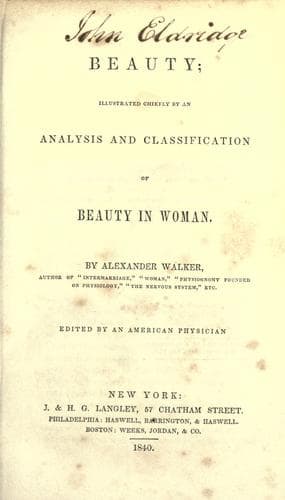
Beauty: Illustrated Chiefly by an Analysis and Classification of Beauty in WomanWalker, Alexander
Philosophy
Beauty: Illustrated Chiefly by an Analysis and Classification of Beauty in Woman
Walker, Alexander
Beauty, Personal; Women
The native country of beauty is not to be found either in regions where
cold freezes up the living juices, or in those where the animal structure
is withered by heat. A climate removed from the excessive influence of
both these causes constitutes an essential condition in the production of
beauty; and this, with its effect, we find between the 35th and 65th
degree of northern latitude, in Persia, the countries bordering upon
Caucasus, and principally Tchercassia, Georgia and Mongrelia, Turkey in
Europe and Asia, Greece, Italy, some part of Spain, a very small part of
France, England, Holland, some parts of Germany, Poland, Denmark, Sweden,
and a part of Norway and even of Russia.
Even under the same degree of latitude, it is observed that the position
of the place, its elevation, its vicinity to the sea, the direction of the
winds, the nature of the soil, and all the peculiarities of locality which
constitute the climate proper to each place, occasion great differences in
beauty.
In relation to the causes of beauty, some observations which seem to be
important, arise out of the remarks of de Pauw on the Greeks.
De Pauw endeavored to show, that, though the men of ancient Greece were
handsome, the women of that country were never beautiful. He thence
accounted for the excessive admiration which there prevailed of courtesans
from Ionia, &c.
This, however, was so contrary to the notions formed of the beauty of that
people from what was known of their taste, that it was considered as a
paradox. Travellers, accordingly, sought for such beauty in the women of
modern Greece. They were disappointed in not finding it.
What rendered this the more remarkable was, that in various places they
found the ancient and beautiful cast of countenance among the men, and not
among the women of that country--thus corroborating in all respects the
doctrine of de Pauw.
On considering that doctrine, however, and comparing it with more extended
observations, it would seem to be only a particular application of a more
general law unknown to de Pauw--that, in most countries, one of the sexes
excels the other in beauty.
Thus, in some parts of the highlands of Scotland, we find the men as
remarkable for beauty as the women for ugliness; while, in some eastern
counties of England, we find precisely the reverse. The strong features,
the dark curled hair and the muscular form, of the highlander, are as
unsuitable to the female sex, as the soft features, the flaxen hair, and
the short and tapering limbs, of the woman of the eastern coast, are
unsuitable to the male.
If the soil, climate, and productions, of these countries be considered,
we discover the causes of the differences alluded to. The hardships of
mountain life are favorable to the stronger development of the locomotive
system, which ought more or less to characterize the male; and the
luxuriance of the plains is favorable to those developments of the
nutritive system, which ought to characterize the female.
Public-domain text, read in full here on John Shaqi.
Reviews
Reviews
No reviews yet
Be the first to share your thoughts on this work.
Elsewhere in the archive
Join the Discussion
Join the discussion
Sign in to leave a comment or review.
Sign InorCreate an account