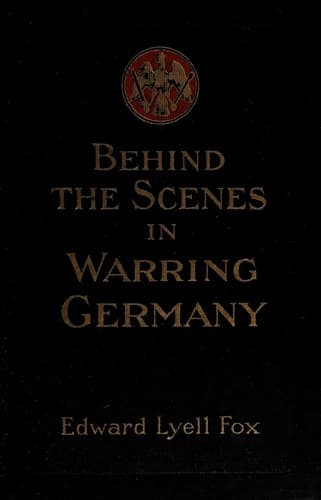
Behind the Scenes in Warring GermanyFox, Edward Lyell
History
Behind the Scenes in Warring Germany
Fox, Edward Lyell
World War, 1914-1918 -- Personal narratives
An automobile of the Flying Corps shrieked past. We came into a zone of
looted shops. We entered a store where bottled liquors had been sold, a
chaos now of smashed glass. On the day of the battle when all discipline
flew to the winds the Russians had evidently sought their solace or
courage in vodka. We became aware that not a house nor store in Lyck had
escaped their pillage. As we crossed a little public park we found they
had vented their revenge at defeat by smashing every bench in the
square. Since we learned that no Germans had remained in the town of
Lyck, and no sniping could have been possible, this orgy of broken shop
windows, blown up safes, and robbery, before our eyes, was the
indisputable evidence of Russian barbarism.
We had our coffee in a little inn that had been the Russian Officers'
Casino where a squad of Germans were already at work cleaning out the
filth. Black coffee, black bread, in a room where the wall was riddled
with bullets, from the pistols of drunken Russian officers who had sat
there making a target of a portrait of the German Emperor, now lying on
the floor. A tired officer of the Hussars came in as we left and I heard
him say to Von Stietencron, "So their officers were here, were they?"
And Von Stietencron replied: "I'm afraid they were as bad as their
men...."
We climbed into the automobile, one of the gray-green army cars that I
had seen in the West, and in a few minutes we were rushing by the never
ending transport train. We left Lyck with its pillaged houses and
shelled walls behind and swept across the open country. But we could not
put the war behind us. We overtook a long shuffling column of Russian
prisoners and further on, the Germans who were slightly wounded walking
with almost a springy step in contrast to the dispirited Russians. We
passed another of the gray supply trains, where the sleepy horses of the
Uhlan escort pranced on its flanks. We came to a bridge which the
engineers were rebuilding, and had to make a detour, crossing further up
the stream beside a burned mill, its twisted, charred, water wheel a
mute witness of the devastation that the Russians have brought to this
land.
On the left the ground fell away into a gully and on the bottom of this
I noticed a farmer's sled, the horse in a dead tangle beside it. I
noticed a second sled, a third, a fourth; apparently these sleds having
been met on the road by the beaten Russians were hurled with their
drivers into the gully below.
As we drove into the great square at Goldap, a "goulash cannon," one of
the German field kitchens, was smoking. It was the only smoke we saw in
this once busy town of eight thousand people. We seemed to be standing
in a burned sepulcher for all around us the houses were black with fire
and on the streets no human thing stirred, save soldiers.
Public-domain text, read in full here on John Shaqi.
Reviews
Reviews
No reviews yet
Be the first to share your thoughts on this work.
Elsewhere in the archive
Join the Discussion
Join the discussion
Sign in to leave a comment or review.
Sign InorCreate an account