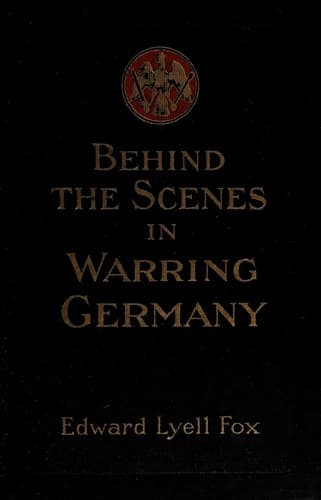
Behind the Scenes in Warring GermanyFox, Edward Lyell
History
Behind the Scenes in Warring Germany
Fox, Edward Lyell
World War, 1914-1918 -- Personal narratives
"After this war, the Englishman will look at his books, he will take his
pencil in his hand and he will begin figuring. He will get up a balance
sheet, and he will find that war does not pay. England is rational to
excess. For years she has been the political clearing house of the
world. She could in this way rule five hundred million people as long as
these people were not striving for nationalism. But Germany attains its
conscious nationalism, and asks herself, Why should I allow the
thirty-eight million people of Great Britain, through their political
clearing house, to have such a dominate influence on the affairs of the
world? Wherefore in the last analysis, this war was caused by the
thorough gaining of national consciousness that English diplomacy has no
longer been able to retard. And under the industrial system of to-day,
things are not done with papers passing through a clearing house, but
with blood.
"I regard this war as an expression of the solidarity of the world on
the minus side. It is an underground solidarity, but is having, for the
moment, a negative influence because commerce is stopped. The United
States is feeling it, it is holding up your country. It is holding up
China which cannot get money for necessary improvements. But all this is
working towards the conscious solidarity of the future, which will be
expressed in a positive war; when fighting will be done not with cannons
but with contracts; when not blood but ink will be wasted."
"You believe then, Professor," I asked, "that the day will come when
there will be no war, when fighting actually will be done with ink?
Suppose that day comes, will it be a good thing? Do you consider
international peace a friend or an enemy to robust normal manhood? Do
you think that war cleans out degenerate tendencies of peaceful
civilization?"
Deciding that this was a metaphysical question, Professor Stein
preferred not to answer it. He did though say this:
"In the Bible it says that the holy fire must be kept burning on the
altar. It is a good thing for the world that there are idealists to keep
the fire going. Men like Carnegie, Rockefeller, and the puritan and
quaker elements, they do their service to the world in this way. The
world must have ideals. International peace is an ideal. It is like the
point of a compass, the north star that the mariner sees, or the star of
the desert. It points the way for those who want to go toward a certain
goal. I say, that as an ideal, it is impossible of achievement, because
the very way to it shows the people where they really want to go."
"But, Professor," I suggested, "if a nation has only ideals, it is going
to get into trouble. I have heard it expressed that the peace movement
has done the United States more harm than good. Will you, as one of its
hardest workers, give some message to the people of America, on the
status of international peace to-day and in the future?"
Public-domain text, read in full here on John Shaqi.
Reviews
Reviews
No reviews yet
Be the first to share your thoughts on this work.
Elsewhere in the archive
Join the Discussion
Join the discussion
Sign in to leave a comment or review.
Sign InorCreate an account