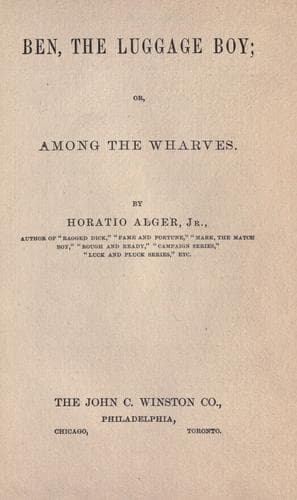
Ben, the Luggage Boy; Or, Among the WharvesAlger, Horatio, Jr.
History
Ben, the Luggage Boy; Or, Among the Wharves
Alger, Horatio, Jr.
New York (N.Y.) -- History -- Fiction; Runaways -- Fiction
Ben also gave up smoking,--not so much because he considered it
injurious, but because cigars cost money, and he was economizing in
every possible way. He continued to sleep in the room under the wharf,
which thus far the occupants had managed to keep from the knowledge of
the police. Gradually the number had increased, until from twenty to
thirty boys made it a rendezvous nightly. By some means a stove had been
procured, and what was more difficult, got safely down without
observation, so that, as the nights grew cooler, the boys managed to
make themselves comfortable. Here they talked and told stories, and had
a good time before going to sleep. One evening it was proposed by one of
the boys that each should tell his own story; for though they met
together daily they knew little of each other beyond this, that they
were all engaged in some street avocation. Some of the stories told were
real, some burlesque.
First Jim Bagley told his story.
"I aint got much to tell, boys," he said. "My father kept a cigar store
on Eighth Avenue, and my mother and sister and I lived behind the shop.
We got along pretty well, till father got run over by a street-car, and
pretty soon after he died. We kept the store along a little while, but
we couldn't make it go and pay the rent; so we sold out to a man who
paid half down, and promised to pay the rest in a year. But before the
year was up he shut up the shop, and went off, and we never got the rest
of the money. The money we did get did not last long. Mother got some
sewin' to do, but she couldn't earn much. I took to sellin' papers; but
after a while I went into the match business, which pays pretty good. I
pay mother five dollars a week, and sometimes more; so she gets along
well."
"I don't see how you make so much money, Jim," said Phil Cranmer. "I've
tried it, and I didn't get nothin' much out of it."
"Jim knows how," said one of the boys. "He's got enterprise."
"I go off into the country a good deal," said Jim. "There's plenty of
match boys in the city. Sometimes I hire another boy to come along and
help me. If he's smart I make money that way too. Last time I went out I
didn't make so much."
"How was that, Jim?"
"I went up to Albany on the boat. I was doin' pretty well up there, when
all to once they took me up for sellin' without a license; so I had to
pay ten dollars afore they'd let me off."
"Did you have the money to pay, Jim?"
"Yes, but it cleaned me out, so I didn't have but two dollars left. But
I travelled off into the country towns, and got it back in a week or
two. I'm glad they didn't get hold of Bill."
"Who was Bill?"
"The feller that sold for me. I couldn't have paid his fine too. That's
about all I have to tell."[B]
"Captain Jinks!" called out one of the boys; "your turn next."
Attention was directed to a tall, overgrown boy of sixteen, or possibly
seventeen, to whom for some unknown reason the name of the famous
Captain Jinks had been given.
"That aint my name," he said.
Public-domain text, read in full here on John Shaqi.
Reviews
Reviews
No reviews yet
Be the first to share your thoughts on this work.
Elsewhere in the archive
Join the Discussion
Join the discussion
Sign in to leave a comment or review.
Sign InorCreate an account