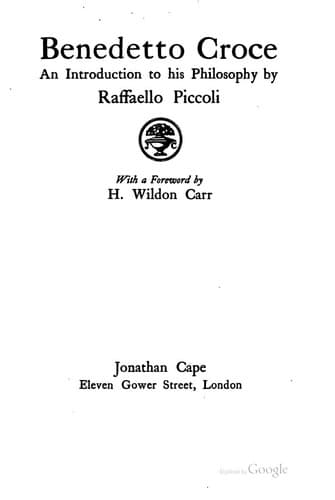
Benedetto Croce: An Introduction to His PhilosophyPiccoli, Raffaello
Philosophy
Benedetto Croce: An Introduction to His Philosophy
Piccoli, Raffaello
Aesthetics; Croce, Benedetto, 1866-1952
from the ethical to the economic, when, as in the case of theological
utilitarianism, they are taken as empirical limitations, as particular
objects, of the ethical will. The material ethical principles are in
fact analogous to those material æsthetic principles which we have
criticised as rhetorical; they constitute a rhetoric of the virtues not
less deadly to the creative moral will than the rhetoric of the arts is
to the creative intuition.
The ethical principle must be formal, but not formalistic, and
therefore Croce is not satisfied with any of the so-called universal
laws or categorical imperatives, or with any of the many formulas
which attempt to define the moral actions through one constant
determination which ought to be present in each of them. Such formulas
are mere symbols or metaphors, and can be used as the equivalents of
the ethical principle, as some of the categories of material ethics
can be used; but their danger consists in giving the illusion of
possessing the true principle, while what we are given is an empty
and tautological one, which will again give way to purely empirical
determinations and therefore to utilitarianism. This empty formalism,
or absolute indetermination, of the ethical principle, corresponds to
two conceptions of philosophy, which Croce respectively calls partial
and discontinuous. According to the first, man may know a portion of
reality, but never reality as a whole; as regards morality, he may hear
the voice of his own conscience, but never grasp with his intellect
the content of the moral law. According to the second, he may know the
reason of morality, but not within the sphere of ethics, whose task
consists only in establishing the moral law and deducing the moral
precepts; the problem of the essence of morality belongs to another
science, metaphysics. The reader who has followed us to this point
knows that Croce's philosophy is neither partial nor discontinuous;
that he does not admit of any limits to human thought, nor of any
division in the body of philosophy. The whole of philosophy is already
included for him in the first philosophical proposition, and though it
may didactically be useful to divide the problems of philosophy in
groups, or even to deal separately with the particular philosophical
science on one hand, and with general philosophy or metaphysics on the
other, yet truth does not belong to the distinctions outside their
unity, to the parts outside the whole, to the segments outside the
circle. It is this totality and continuity of Croce's philosophy that
makes Croce's ethical principle a form, but not an empty one; a form
which is full in a philosophical and universal sense, which is at the
same time content, and universal as content not less than as form. He
has defined the ethical principle, not, tautologically, as a universal
form, but as the volition of the universal: a definition which is
at the same time the distinction of the ethical from the economical
Public-domain text, read in full here on John Shaqi.
Reviews
Reviews
No reviews yet
Be the first to share your thoughts on this work.
Elsewhere in the archive
Join the Discussion
Join the discussion
Sign in to leave a comment or review.
Sign InorCreate an account