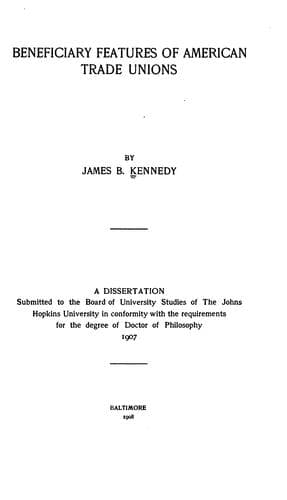
Beneficiary Features of American Trade UnionsKennedy, James Boyd
History
Beneficiary Features of American Trade Unions
Kennedy, James Boyd
Fraternal insurance -- United States; Labor unions -- United States
The ratio of disability benefits paid to death benefits paid varies in
the different unions according to the definition of disability adopted.
The Iron Molders' Union, which took the initiative in adopting a
national disability benefit, undertook to pay benefits to all disabled
members, with two exceptions. First, the disability must not have been
caused by dissipation, and secondly, the member must not have been
disabled before joining the Association.[107] The Granite Cutters'
Union, however, when establishing their voluntary insurance association
in 1877, limited the benefit to members disabled for life by any real
accident suffered while following employment as a granite cutter.[108]
The two benefits were unlike in that the Iron Molders paid the benefit
no matter how the disability had been incurred, while the Granite
Cutters paid only when the disability resulted from a trade accident.
[Footnote 107: Constitution of the Iron Molders' Union of North America,
1878 (Cincinnati, 1878), p. 51.]
[Footnote 108: Constitution of the Granite Cutters' International
Association of America, 1877 (Rockland, 1877), p. 27.]
Some of the unions now paying the disability benefit, as for example the
Boot and Shoe Workers, have followed the policy of the Iron Molders in
paying the benefit in all cases of disability; while others, for example
the Brotherhood of Carpenters, pay only where the disability is incurred
"while working at the trade." Under this system, in the case of the Iron
Molders, the claims for disability were so numerous that in 1882 the
term "permanent disability" was defined to mean "total blindness, the
loss of an arm or leg, or both," and since 1890 also paralysis.[109]
Similarly in 1880 the Granite Cutters defined more exactly what
constituted total disability.[110]
[Footnote 109: Constitution, 1882 (Cincinnati, 1882), Art. 17; Iron
Molders' Journal, Vol. 16, June and August, 1880; Constitution, 1890
(Cincinnati, 1890); Constitution, 1902 (Cincinnati, 1902), p. 40.]
[Footnote 110: Constitution, 1880 (Maplewood, 1880), p. 18.]
Public-domain text, read in full here on John Shaqi.
Reviews
Reviews
No reviews yet
Be the first to share your thoughts on this work.
Elsewhere in the archive
Join the Discussion
Join the discussion
Sign in to leave a comment or review.
Sign InorCreate an account