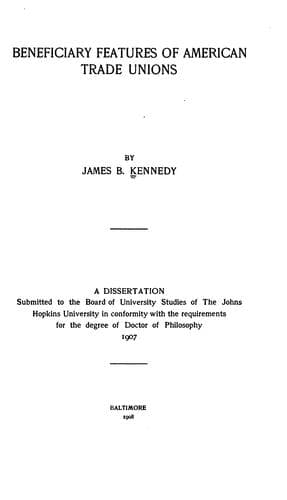
Beneficiary Features of American Trade UnionsKennedy, James Boyd
History
Beneficiary Features of American Trade Unions
Kennedy, James Boyd
Fraternal insurance -- United States; Labor unions -- United States
The younger unions have usually adopted the later revised definition of
the term "permanent or total disability," with such modifications as are
made necessary by the peculiar nature of the trade. The system of the
Brotherhood of Carpenters and Joiners, adopted in 1886, and still in
force, defines permanent disability as "total blindness, the loss of an
arm or leg, or both, the total disability of a limb, the loss of four
fingers on one hand, or being afflicted with any physical disability
resulting from sudden accident."[111] The Amalgamated Glass Workers as
late as 1900 had made no attempt to give definite limits to the term
"total disability," but in 1903 they adopted the definition of the
Carpenters and extended it to include disability resulting from
paralysis.[112] The Amalgamated Wood Workers, however, still provide
simply that to receive the benefit members shall be disabled from
following the trade.[113]
[Footnote 111: Constitution, 1886 (n.p., n.d.), p. 11; Constitution,
1905 (Milwaukee, n.d.), p. 19.]
[Footnote 112: Constitution, 1900 (Chicago, n.d.), p. 23; Constitution,
1903, p. 11.]
[Footnote 113: Constitution of the Amalgamated Wood-Workers'
International Union of America, 1905 (Chicago, n.d.), p. 42.]
The definitions adopted by the unions are intended as guides for and
restrictions upon the administrative officials, but in all cases the
latter are given considerable latitude. The cost of the benefit,
therefore, depends largely upon the strictness with which the officials
construe the rules. In those unions where the injuries entitling to a
benefit are not specifically defined, the officers have great
discretionary power. Indeed, even if they have the best intention, it is
in many trades often impossible to obtain positive evidence as to the
totality or permanency of the disability. For example, the Brotherhood
of Painters find it almost impossible to pass intelligently upon claims
for disability resulting from lead poisoning.
The table on page 63 shows the sums paid for death and disability claims
in certain unions for which statistics are procurable.
The addition of a disability benefit to the death benefit as appears
from the table does not add greatly to the cost of maintaining the
benefit. In general, the amount paid for disability ranges from five to
ten per cent. of the total paid for both benefits. The cost of the
benefits is somewhat increased also by the loss of dues from the time of
the disability to the death of the insured.
Public-domain text, read in full here on John Shaqi.
Reviews
Reviews
No reviews yet
Be the first to share your thoughts on this work.
Elsewhere in the archive
Join the Discussion
Join the discussion
Sign in to leave a comment or review.
Sign InorCreate an account