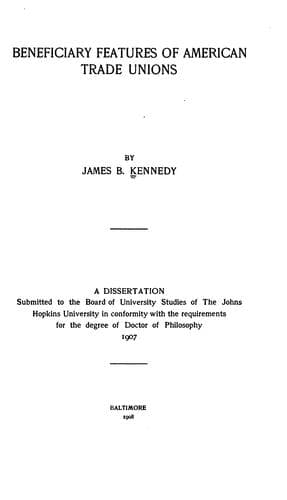
Beneficiary Features of American Trade UnionsKennedy, James Boyd
History
Beneficiary Features of American Trade Unions
Kennedy, James Boyd
Fraternal insurance -- United States; Labor unions -- United States
The success of the wife's death or funeral benefit is not beyond
controversy. The Tailors, who began to pay the benefit in 1889,
abandoned it in 1898. The benefit was at first seventy-five dollars
after three months' membership, but it was remodelled until in 1896 it
became a graded benefit ranging from twenty-five dollars to fifty
dollars according to the length of membership. The chief objection to
the benefit was that unmarried members were taxed to support the benefit
although they did not participate in the advantages. In 1898 Secretary
Lennon declared that the benefit "was based on real injustice, giving
one member more benefits for the same dues paid than to another."[119]
In other unions which maintain the benefit this objection has been met
to some extent, as in the Cigar Makers, by paying the benefit on the
death of the widowed mother of an unmarried member provided she was
solely dependent upon him for support. Provision is usually made that no
member shall receive the wife's funeral benefit more than once. This
rule is intended partly to prevent fraud but chiefly to meet the
complaint that the benefit confers unequal advantages.
[Footnote 119: The Tailor, Vol. 8, No. 1, p. 16.]
The unions which have adopted the benefit have all experienced
difficulty in safeguarding it against fraudulent claims. They usually
require, for eligibility to the benefit, that the wife be not in ill
health at the time the member is admitted to the union. In the unions
which have had the benefit longest in operation it has been found
possible materially to lessen the number of claims for the wife's
benefit after some experience in its operation.
The following table shows the percentage of claims paid by the Painters
for wife's and member's death benefits for a series of biennial periods:
====================================
| Percentage | Percentage
| of Wife's | of Member's
Year. | Death | Death
| Benefits. | Benefits.
------------------------------------
1889-1890 | 49.1 | 50.9
1890-1892 | 43.5 | 56.5
1892-1894 | 45 | 55
1894-1896 | 37.5 | 62.5
1896-1900 | 35.3 | 64.7
1900-1902 | 32.5 | 67.5
1902-1904 | 32.6 | 67.4
------------------------------------
It will be observed that the ratio of the number of wife's funeral
benefits to the number of member's funeral benefits has steadily fallen
for a considerable number of years. The experience of the Painters is
probably typical, although the number of claims of each kind is not
ascertainable in the other unions.
The combination of the wife's funeral benefit with the death benefit
causes a material addition in the cost of the death benefit. This
increase is greatest in those unions in which the wife's benefit is
relatively large in amount. The following table shows the sums paid for
member's and wife's death benefits in three of the more important
unions:
Public-domain text, read in full here on John Shaqi.
Reviews
Reviews
No reviews yet
Be the first to share your thoughts on this work.
Elsewhere in the archive
Join the Discussion
Join the discussion
Sign in to leave a comment or review.
Sign InorCreate an account