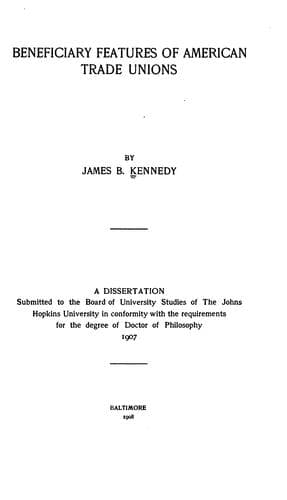
Beneficiary Features of American Trade UnionsKennedy, James Boyd
History
Beneficiary Features of American Trade Unions
Kennedy, James Boyd
Fraternal insurance -- United States; Labor unions -- United States
The sick benefit is intended to support members and their families while
the member is unable, through illness, to work. Such sickness, to
entitle a member to the benefit, must in all the unions be an illness
which prevents him from "attending to his usual vocations."[142]
Practically all the unions provide, however, that if the sickness is
the result of "intemperance, debauchery or other immoral conduct" the
benefit shall not be paid. A few of the unions also specifically provide
that illness "caused by the member's own act" shall not constitute a
claim for the benefit.[145]
[Footnote 142: Iron Molders' Constitution, 1902 (Cincinnati, 1902), p.
37; Cigar Makers' Constitution, 1896, fourteenth edition (Chicago,
n.d.), p. 34; Tobacco Workers' Constitution, 1900, third edition, 1905
(Louisville, n.d.), p. 25; Barbers' Constitution, 1902, p. 10; Garment
Workers' Constitution, 1902, p. 37; Piano and Organ Workers'
Constitution, 1902 (n.p., 1903), p. 18; Boot and Shoe Workers'
Constitution, 1906, p. 31; Pattern Makers' Constitution, 1906, p. 48;
Leather Workers on Horse Goods' Constitution, 1905, p. 21.]
[Footnote 145: The Boot and Shoe Workers, who have a large number of
female members, provide that "female members shall not be entitled to
[sick] benefits while pregnant nor for five weeks after confinement"
(Constitution, 1906, sec. 64).]
In nearly all of the unions a member must have been in continuous good
standing for six months to be entitled to receive the sick benefit. The
Plumbers require that he shall have been a member for a year. Such
requirements afford protection to some extent against persons in ill
health joining the unions in order to receive the benefit. The unions
rely almost entirely upon those provisions to prevent such abuse. In
practically none is an examination regularly required in order to
determine whether the candidate for admission to the union is likely to
be a heavy risk. Certain of them do provide, however, that in case the
candidate at the time of his admission is over a fixed age, or in case
he is afflicted with a chronic disease, he shall be entitled to a
smaller weekly benefit than would otherwise be the case. Thus, in the
Typographia members fifty years of age and those passing unsatisfactory
medical examinations pay five cents less weekly dues than regular
members, but can draw no benefit until after two years' good standing.
At the expiration of this period they may receive three dollars per
week, two dollars less than the regular benefit, for fifty weeks, and
then one dollar and fifty cents, half of the regular benefit, for
another fifty weeks.
Public-domain text, read in full here on John Shaqi.
Reviews
Reviews
No reviews yet
Be the first to share your thoughts on this work.
Elsewhere in the archive
Join the Discussion
Join the discussion
Sign in to leave a comment or review.
Sign InorCreate an account