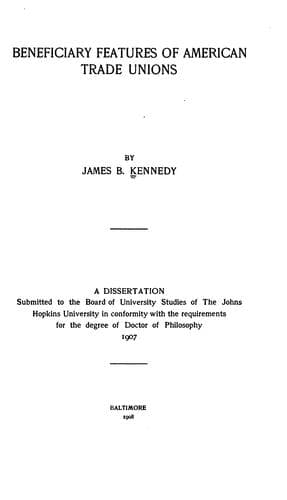
Beneficiary Features of American Trade UnionsKennedy, James Boyd
History
Beneficiary Features of American Trade Unions
Kennedy, James Boyd
Fraternal insurance -- United States; Labor unions -- United States
1898 | 111,283.60| 3.90| 3,983.85| 3.62 | 37,710.00| 1.50| |
1899 | 107,785.07| 3.45| 4,506.35| 4.20 | 57,465.00| 1.98|$ 855.00|$ .90
1900 | 117,455.84| 3.21| 4,651.65| 4.45 | 102,935.00| 2.49| 2,105.00| .88
1901 | 134,614.11| 3.65| 4,316.81| 4.22 | 118,515.00| 2.46| 4,870.00| 1.22
1902 | 137,403.45| 3.47| 4,977.98| 4.99 | 134,116.00| 2.47| 8,595.00| 1.81
1903 | 147,054.56| 3.42| 3,767.93| 3.77 | 179,355.00| 2.78| 11,680.00| 1.90
1904 | 163,226.18| 3.59| 2,945.68| 2.96 | 198,214.25| 2.59| 16,940.00| 2.18
1905 | 165,917.00| 3.73| 4,835.45| 4.95 | 174.946.28| | 14,345.00| 2.13
1906 | 162,905.82| 3.70| 2,945.68| 3.02 | 176,799.00| | |
------------------------------------------------------------------------------
Differences in the rate of morbidity in different trades affect the
cost, but these are relatively unimportant in the unions considered. A
more important cause of difference in cost is the extent to which the
unions are able to prevent the sick benefit from becoming a pension to
members incapacitated by old age and disease. The heavy cost in the
Typographia is partly due to the more liberal provision which is made
for such members. In those unions, such as the Iron Molders and the
Leather Workers on Horse Goods, which do not maintain an out-of-work
benefit, the cost of the sick benefit is undoubtedly somewhat higher
than it would be on account of the temptation of the unemployed member
to feign illness.
CHAPTER IV.
OUT-OF-WORK BENEFITS.
The out-of-work benefit, of prime importance among English trade unions,
has made little headway in America either as a national or even as a
local trade-union benefit. In 1905 the amount expended for out-of-work
benefits could not well have exceeded eighty thousand dollars, and of
this sum a considerable part was spent by the Amalgamated Carpenters, a
British trade union with branches in the United States. Certainly less
than one half of one per cent. of the expenditures of American national
unions, and less than one per cent. of their expenditures for
beneficiary purposes, is for out-of-work relief. In the one hundred
principal English trade unions twenty-one per cent. of the total
expenditure in the ten years from 1892 to 1901 was for out-of-work
benefits. Of the sum spent by the same unions for benefits of all kinds
(not including strike pay) about one third was for out-of-work
benefits.[155]
[Footnote 155: Weyl, "Benefit Features of British Trade Unions" in
Bulletin of the Bureau of Labor, No. 64, p. 722.]
Relief to the unemployed member has assumed in American unions three
forms: (_a_) an out-of-work benefit of a fixed amount per week in money,
(_b_) exemption of unemployed members from weekly or monthly dues, and
(_c_) a loan or benefit sufficient to transport the unemployed member in
search of employment. The first and second of these are ordinarily known
as out-of-work benefits, while the third is known as a travelling
benefit.
Public-domain text, read in full here on John Shaqi.
Reviews
Reviews
No reviews yet
Be the first to share your thoughts on this work.
Elsewhere in the archive
Join the Discussion
Join the discussion
Sign in to leave a comment or review.
Sign InorCreate an account