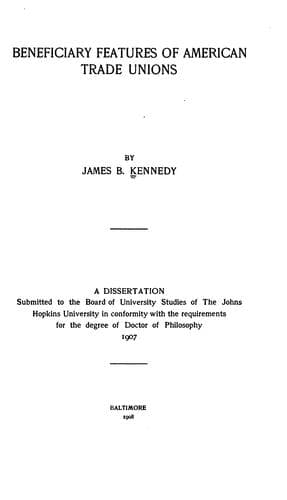
Beneficiary Features of American Trade UnionsKennedy, James Boyd
History
Beneficiary Features of American Trade Unions
Kennedy, James Boyd
Fraternal insurance -- United States; Labor unions -- United States
The Home was opened on May 12, 1892. Applicants for admission were
required to have been members of the union in good standing for five
years. Persons incapacitated either by age or by illness were admitted
to the Home. The number of residents has increased from twenty-two in
1893 to one hundred and forty-three in 1907. A considerable part of the
residents are sufferers from tuberculosis, and the union has made
provision for treating them according to modern methods. A part of the
inmates, however, have always been persons whose incapacity was solely
the result of old age.
About 1904 an agitation began to be carried on in the union for making
more adequate provision for the maintenance of aged members. The
establishment of the Home had made provision only for those
incapacitated members who were willing to leave their families and live
in an institution. It was argued that the Home benefited one class of
the aged, and that another class, equally worthy, was left entirely
dependent upon its own resources. Moreover, certain innovations in the
trade had made the union highly sensible of the helplessness of its aged
members. The introduction of the linotype caused many old members to
lose their employment. The New York local union established an
out-of-work benefit in 1896 which has since been maintained. This
benefit, while nominally an out-of-work benefit, was in many cases
really a superannuation benefit. In 1903 the Chicago local union made
provision for the payment of old-age pensions to its members, and other
local unions rapidly followed the same policy.
In 1903 and 1904 propositions were introduced at the sessions of the
International Union for the establishment of an International old-age
pension system. In 1905 the session of the International authorized the
appointment of a committee to investigate the subject. The eight-hour
strike which taxed for two years the resources of the Union delayed the
consideration of this report. In 1907 the committee reported in favor of
the establishment of old age pensions, and presented a plan which when
submitted to the referendum was ratified by a large majority, and on
August 1, 1908, the International secretary-treasurer began the payment
of pensions. All members sixty years of age who have been in continuous
good standing for twenty years, and who earn less than four dollars per
week, are entitled to a weekly pension of four dollars. The original
plan provided also that in order to receive a pension a member must have
no other means of support. The officers of the Union, however, have
construed this provision liberally, and the pension is paid as of right
and not as a form of charity.
Public-domain text, read in full here on John Shaqi.
Reviews
Reviews
No reviews yet
Be the first to share your thoughts on this work.
Elsewhere in the archive
Join the Discussion
Join the discussion
Sign in to leave a comment or review.
Sign InorCreate an account