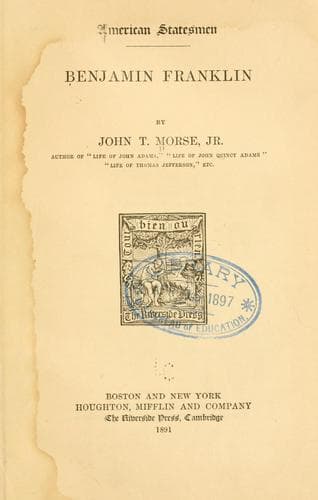
Benjamin FranklinMorse, John T., Jr. (John Torrey)
History
Benjamin Franklin
Morse, John T., Jr. (John Torrey)
Franklin, Benjamin, 1706-1790
But the insuperable trouble was that, at the close of the last war and
before the passage of the Stamp Act, the controversy upon the question
of right had been unborn. Now, having come into being, this controversy
could not be laid at rest by a mere waiver; it was of that nature that
its resurrection would be sure and speedy. Anything else would have
been, of course, the practical victory of the colonies and defeat of
England; and the English could not admit that things had reached this
pass as yet. If England should not renounce her right, the colonies
would always remain uneasy beneath the unretracted assertion of it; if
she should never again seek to exercise it, she would be really
yielding. It was idle to talk of such a state of affairs; it could not
be brought about, even if it were conceivable that each side could be
induced to repeal all its acts and resolves touching the subject,--and
even this preliminary step was what no reasonable man could anticipate.
In a word, when Franklin longed for the restoration of the _status quo
ante_ the Stamp Act, he longed for a chimera. A question had been
raised, which was of that kind that it could not be compromised, or set
aside, or ignored, or forgotten; it must be _settled_ by the recession
or by the defeat of one contestant or the other. Nothing better than a
brief period of restless and suspicious truce could be gained by an
effort to restore the situation of a previous date, even were such
restoration possible, since the intervening period and the memory of its
undetermined dispute concerning a principle could not be annihilated.
Public-domain text, read in full here on John Shaqi.
Reviews
Reviews
No reviews yet
Be the first to share your thoughts on this work.
Elsewhere in the archive
Join the Discussion
Join the discussion
Sign in to leave a comment or review.
Sign InorCreate an account