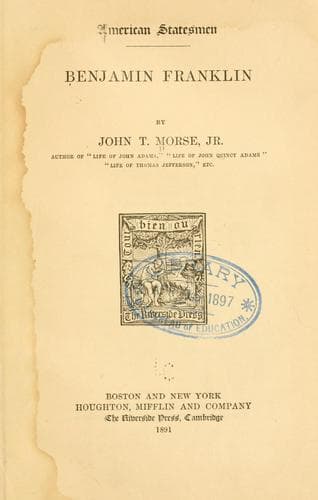
Benjamin FranklinMorse, John T., Jr. (John Torrey)
History
Benjamin Franklin
Morse, John T., Jr. (John Torrey)
Franklin, Benjamin, 1706-1790
responsible for them, and put in a very different set of men, who would
undo the mischief. "If we continue firm and united, and resolutely
persist in the non-consumption agreement, this adverse ministry cannot
possibly stand another year. And surely the great body of our people,
the farmers and artificers, will not find it hard to keep an agreement
by which they both save and gain." Thus he continued to write so late as
February, 1775, believing to the last in the efficacy of this policy.
CHAPTER VII
SECOND MISSION TO ENGLAND, III THE HUTCHINSON LETTERS: THE PRIVY COUNCIL
SCENE: RETURN HOME
The famous episode of the Hutchinson letters, occurring near the close
of Franklin's stay in England, must be narrated with a brevity more in
accord with its real historical value than with its interest as a
dramatic story. In conversation one day with an English gentleman,
Franklin spoke with resentment of the sending troops to Boston and the
other severe measures of the government. The other in reply engaged to
convince him that these steps were taken upon the suggestion and advice
of Americans. A few days later he made good his promise by producing
certain letters, signed by Hutchinson, Oliver, and others, all natives
of and residents and office-holders in America. The addresses had been
cut from the letters; but in other respects they were unmutilated, and
they were the original documents. They contained just such matter as the
gentleman had described,--opinions and advice which would have commended
themselves highly to a royalist, but which could have seemed to a
patriot in the provinces only the most dangerous and abominable
treason. Induced by obvious motives, Franklin begged leave to send these
letters to Massachusetts, and finally obtained permission to do so,
subject to the stipulation that they should not be printed nor copied,
and should be circulated only among a few leading men. His purpose, he
said, lay in his belief that when the "principal people" in Boston "saw
the measures they complained of took their rise in a great degree from
the representations and recommendations of their own countrymen, their
resentment against Britain might abate, as mine has done, and a
reconciliation be more easily obtained."[30] Franklin accordingly sent
over the letters, together with strict injunctions in pursuance of his
engagement to the giver of them: "In confidence of your following
inviolably my engagement," etc., he wrote. But this solemn instruction
was not complied with; the temptation was too great for the honor of
some among the patriots, who resolved that the letters should be made
public despite any pledge to the contrary, and resorted to a shallow
artifice for achieving their end. A story was started that authenticated
copies of the same papers had been received from England by somebody.
There was a prudent abstention from any inquiry into the truth of this
statement. "I know," said Franklin, "that could not be. It was an
Public-domain text, read in full here on John Shaqi.
Reviews
Reviews
No reviews yet
Be the first to share your thoughts on this work.
Elsewhere in the archive
Join the Discussion
Join the discussion
Sign in to leave a comment or review.
Sign InorCreate an account