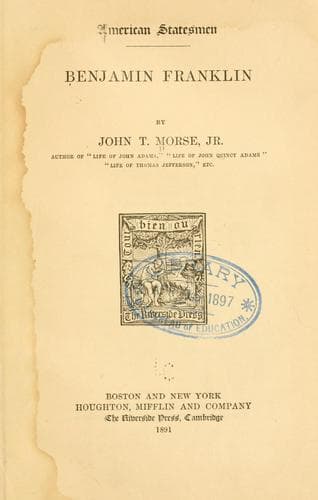
Benjamin FranklinMorse, John T., Jr. (John Torrey)
History
Benjamin Franklin
Morse, John T., Jr. (John Torrey)
Franklin, Benjamin, 1706-1790
Franklin had anticipated that the "king would have considered this
petition, as he had done the preceding one, in his cabinet, and have
given an answer without a hearing." But on the afternoon of Saturday,
January 8, 1774, he was surprised to receive notice of a hearing upon
the petition before the Lords of the Committee for Plantation Affairs,
at the Cockpit, on the Tuesday following, at noon. Late in the afternoon
of Monday he got notice that Mr. Mauduit, agent for Hutchinson and
Oliver, would be represented at the hearing on the following morning by
counsel. A less sagacious man than Franklin would have scented trouble
in the air. He tried to find Arthur Lee; but Lee was in Bath. He then
sought advice from Mr. Bollan, a barrister, agent for the Council of
Massachusetts Bay, and who also had been summoned. There was no time to
instruct counsel, and Mr. Bollan advised to employ none; he had found
"lawyers of little service in colony cases." "Those who are eminent and
hope to rise in their profession are unwilling to offend the court,
whose disposition on this occasion was well known." The next day at the
hearing Mr. Bollan endeavored to speak; but, though he had been
summoned, he was summarily silenced, on the ground that the colonial
Council, whose agent he was, was not a party to the petition. Franklin
then laid the petition and authenticated copies of the letters before
the committee. Some objections to the receipt of copies instead of
originals were raised by Mr. Wedderburn, solicitor-general and counsel
for Hutchinson and Oliver. Franklin then spoke with admirable keenness
and skill. He said that he had not conceived the matter to call for
discussion by lawyers; but that it was a "question of civil or political
prudence, whether, on the state of the fact that the governors had lost
all trust and confidence with the people, and become universally
obnoxious, it would be for the interest of his majesty's service to
continue them in those stations in that province." Of this he conceived
their lordships to be "perfect judges," not requiring "assistance from
the arguments of counsel." Yet if counsel was to be heard he asked an
adjournment to enable him to engage and instruct lawyers. Time was
accordingly granted, until January 29. Wedderburn waived his objection
to the copies, but both he and Lord Chief Justice De Grey intimated that
inquiry would be made as to "how the Assembly came into possession of
them, through whose hands and by what means they were procured, ... and
to whom they were directed." This was all irrelevant to the real issue,
which had been sharply defined by Franklin. The lord president, near
whom Franklin stood, asked him whether he intended to answer such
questions. "In that I shall take counsel," replied Franklin.
Public-domain text, read in full here on John Shaqi.
Reviews
Reviews
No reviews yet
Be the first to share your thoughts on this work.
Elsewhere in the archive
Join the Discussion
Join the discussion
Sign in to leave a comment or review.
Sign InorCreate an account