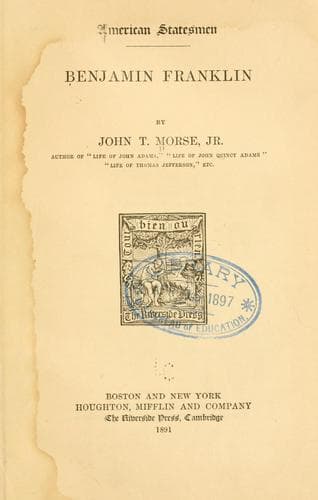
Benjamin FranklinMorse, John T., Jr. (John Torrey)
History
Benjamin Franklin
Morse, John T., Jr. (John Torrey)
Franklin, Benjamin, 1706-1790
person who stole them." "I hope, my lords, you will mark and brand the
man, for the honor of this country, of Europe, and of mankind." "He has
forfeited all the respect of societies and of men. Into what companies
will he hereafter go with an unembarrassed face or the honest
intrepidity of virtue? Men will watch him with a jealous eye; they will
hide their papers from him, and lock up their escritoires. He will
henceforth esteem it a libel to be called _a man of letters_, _homo_
TRIUM[33] _literarum_." "But he not only took away the letters
from one brother, but kept himself concealed till he nearly occasioned the
murder of the other. It is impossible to read his account, expressive of the
coolest and most deliberate malice, without horror. Amidst these
tragical events,--of one person nearly murdered, of another answerable
for the issue, of a worthy governor hurt in his dearest interests, the
fate of America in suspense,--here is a man who, with the utmost
insensibility of remorse, stands up and avows himself the author of all.
I can compare it only to Zanga, in Dr. Young's 'Revenge.'
[Note 33: A play upon the Latin word, FUR, a thief.]
'Know then 't was--I;
I forged the letter, I disposed the picture;
I hated, I despised, and I destroy.'
I ask, my lords, whether the revengeful temper attributed, by poetic
fiction only, to the bloody African, is not surpassed by the coolness
and apathy of the wily American."
Such was the torrent of vilification which flowed from the lips of one
of the meanest of England's lawyers, and the speaker was constantly
encouraged by applause, and by various indications of gratification on
the part of the tribunal before which he argued. Dr. Priestley, who was
present, said that from the opening of the proceedings it was evident
"that the real object of the court was to insult Dr. Franklin," an
object in which their lordships were, of course, able to achieve a
complete success. "No person belonging to the council behaved with
decent gravity, except Lord North," who came late and remained standing
behind a chair. It was a disgraceful scene, but not of long duration;
apparently there was little else done save to hear the speeches of
counsel. The report of the lords was dated on the same day, and was a
severe censure upon the petition and the petitioners. More than this,
their lordships went out of their way to inflict a wanton outrage upon
Franklin. The question of who gave the letters to him was one which all
concerned were extremely anxious to hear answered. But it was also a
question which he could not lawfully be compelled to answer in these
proceedings; it was wholly irrelevant; moreover it was involved in the
cause then pending before the lord chancellor in which Franklin was
respondent. Accordingly, by advice of counsel, advice unquestionably
correct, he refused to divulge what their lordships were so curious to
hear. Enraged, they said in their report that his "silence" was abundant
Public-domain text, read in full here on John Shaqi.
Reviews
Reviews
No reviews yet
Be the first to share your thoughts on this work.
Elsewhere in the archive
Join the Discussion
Join the discussion
Sign in to leave a comment or review.
Sign InorCreate an account