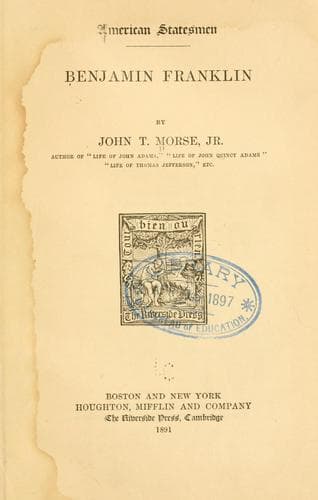
Benjamin FranklinMorse, John T., Jr. (John Torrey)
History
Benjamin Franklin
Morse, John T., Jr. (John Torrey)
Franklin, Benjamin, 1706-1790
It put upon him a judicial stigma, which was ample excuse for the
enemies of America henceforth to treat him as both dishonored and
dishonorable. Hitherto his tact and his high character had preserved him
in a great measure from the social annoyances and curtailments which he
would naturally have suffered as the prominent representative of an
unpopular cause. But it seemed now as if his judgment had once and
fatally played him false, and certainly his good name and his prestige
were given over to his enemies, who dealt cruelly with them. He felt
that it was the end of his usefulness, also that his own self-respect
and dignity must be carefully preserved; and he wrote to the Assembly of
Massachusetts to say that it would be impossible for him longer to act
as its agent. From that time he never attended the levee of a minister.
The portcullis had dropped; the days of his service in England were
over.
The conclusion had come painfully, yet it was not without satisfaction
that he saw himself free to return home. His affairs had suffered in his
absence, and needed his attention now more than ever, since he was
deprived of his income from the post-office. Moreover his efforts could
no longer be cheered with hopes of success or even of achieving any
substantial advantage for his countrymen. He was obliged to admit that
the good disposition of Lord Dartmouth had had no practical results. "No
single measure of his predecessor has since been even attempted to be
changed, and, on the contrary, new ones have been continually added,
further to exasperate these people, render them desperate, and drive
them, if possible, into open rebellion." It had been a vexatious
circumstance, too, that not long before this time he had received a
rebuke from the Massachusetts Assembly for having been lax, as they
fancied, in notifying them of some legislation of an injurious
character, which was in preparation. "This censure," he said, "though
grievous, does not so much surprise me, as I apprehended all along from
the beginning that between the friends of an old agent, my predecessor,
who thought himself hardly used in his dismission, and those of a young
man impatient for the succession, my situation was not likely to be a
very comfortable one, as my faults could scarce pass unobserved." This
reference to the malicious and untrustworthy back-biter, Arthur Lee,
might have been much more severe, and still amply deserved. The most
important acts of his ignoble life, by which alone his memory is
preserved, were the slanders which he set in circulation concerning
Franklin. Yet Franklin, little suspicious and very magnanimous, praised
him as a "gentleman of parts and ability," likely to serve the province
with zeal and activity. Probably from this impure Lee fount, but
possibly from some other source, there now came a renewal of the rumors
that Franklin was to be gained over to the ministerial side by
promotion to some office superior to that which he had held. The
Public-domain text, read in full here on John Shaqi.
Reviews
Reviews
No reviews yet
Be the first to share your thoughts on this work.
Elsewhere in the archive
Join the Discussion
Join the discussion
Sign in to leave a comment or review.
Sign InorCreate an account