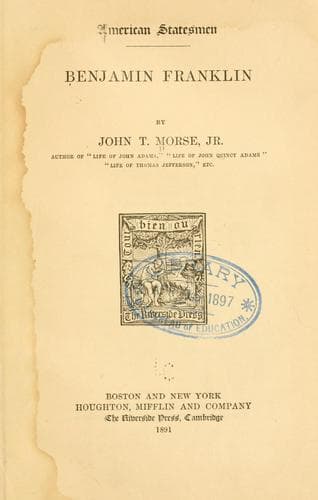
Benjamin FranklinMorse, John T., Jr. (John Torrey)
History
Benjamin Franklin
Morse, John T., Jr. (John Torrey)
Franklin, Benjamin, 1706-1790
He was still consulted by both sides in England. In the August following
the scene in the privy council chamber, he called upon Lord Chatham and
had a long and interesting interview. He then said that he attributed
the late "wrong politics" to the departure from the old and true British
principle, "whereby every province was well governed, being trusted in a
great measure with the government of itself." When it was sought to take
this privilege from the colonies, grave blunders had inevitably ensued;
because, as he admirably expressed it, Parliament insisted upon being
_omnipotent_ when it was not _omniscient_. In other words, the affairs
of the unrepresented colonies were mismanaged through sheer ignorance.
It is noteworthy that England has since recognized the necessity of
precisely the principle indicated by Franklin for colonial government;
all her great colonies are now "trusted in a great measure with the
government" of themselves, and are consequently "well governed."
Franklin further assured his lordship that in all his travels in the
provinces he had never once heard independence hinted at as a desirable
thing. This gave Chatham much pleasure; but perhaps neither of them at
the moment reflected how many eventful years had elapsed since Franklin
was last journeying in America. He further declared that the colonists
were "even not against regulations of the general commerce by
Parliament, provided such regulations were _bona fide_ for the benefit
of the _whole empire_, not to the small advantage of one part to the
great injury of another." This, by the way, was a good point, which he
found very serviceable when people talked to him about the unity of the
empire. A genuine unity was just the gospel which he liked to preach.
"An equal dispensation," he said, "of protection, rights, privileges,
and advantages is what every part is entitled to, and ought to enjoy, it
being a matter of no moment to the state whether a subject grows rich
and flourishing on the Thames or the Ohio, in Edinburgh or Dublin." But
no living Englishman could accept this broad and liberal doctrine. The
notion that the colonies were a dependency and should be tributary to
the greater power was universal. It was admitted that they should not be
oppressed; but it was believed that between oppression and that perfect
unity which involved entire equality there was certainly a middle ground
whereon the colonies might properly be established.
Public-domain text, read in full here on John Shaqi.
Reviews
Reviews
No reviews yet
Be the first to share your thoughts on this work.
Elsewhere in the archive
Join the Discussion
Join the discussion
Sign in to leave a comment or review.
Sign InorCreate an account