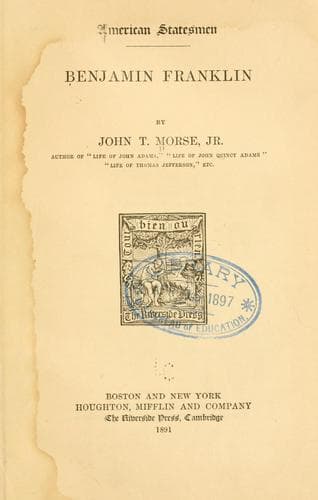
Benjamin FranklinMorse, John T., Jr. (John Torrey)
History
Benjamin Franklin
Morse, John T., Jr. (John Torrey)
Franklin, Benjamin, 1706-1790
The last business which Franklin had to transact on the eve of his
departure came in the shape of one of those mysterious and obscure bits
of negotiation which are at times undertaken by private persons who are
very "near" to ministers, and who conduct their affairs with impressive
secrecy. Just how much this approach amounted to it is difficult to say;
no less a person than Lord Howe was concerned in it, and he was
undoubtedly in direct communication with Lord North. But whether that
potentate really anticipated any substantial good result may be doubted.
Franklin himself has told the story with much particularity, and since
it will neither bear curtailment nor admit of being related at length,
and since the whole palaver accomplished absolutely nothing, the
relation will be omitted here. In the course of it the efforts to bribe
Franklin were renewed, and briefly rejected by him. Also he met, and
established a very friendly personal relation with, Lord Howe, who
afterward commanded the British fleet in American waters.
Having discovered the emptiness of this business, Franklin at last
completed his arrangements for his return home. He placed his agencies
in the hands of Arthur Lee. His last day in London he passed with his
stanch old friend. Dr. Priestley, and a large part of the time, says the
doctor, "he was looking over a number of American newspapers, directing
me what to extract from them for the English ones; and in reading them
he was frequently not able to proceed for the tears literally running
down his cheeks." Such was the depth of feeling in one often accounted
callous, indifferent, or even untrustworthy in the matter of American
relations with England. He felt some anxiety as to whether his departure
might not be prevented by an arrest, and made his journey to Portsmouth
with such speed and precautions as were possible.[36] But he was not
interrupted, and sailed on some day near the middle of March, 1775. His
departure marked an era in the relations of Great Britain with her
American colonies. It signified that all hope of agreement, all
possibility of reconciliation upon one side or of recession upon the
other, were absolutely over. That Franklin gave up in despair the task
of preventing a war meant that war was certain and imminent. He arrived
in Philadelphia May 5, 1775. During his absence his wife had died, and
his daughter had married a young man, Richard Bache, whom he had never
yet seen.
[Note 36: Parton's _Life of Franklin_, ii. 70.]
CHAPTER VIII
SERVICES IN THE STATES
Public-domain text, read in full here on John Shaqi.
Reviews
Reviews
No reviews yet
Be the first to share your thoughts on this work.
Elsewhere in the archive
Join the Discussion
Join the discussion
Sign in to leave a comment or review.
Sign InorCreate an account