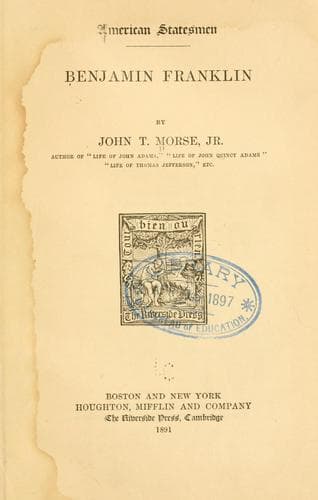
Benjamin FranklinMorse, John T., Jr. (John Torrey)
History
Benjamin Franklin
Morse, John T., Jr. (John Torrey)
Franklin, Benjamin, 1706-1790
De Vergennes set out his views, in agreement with Beaumarchais. He
declared that France now had her opportunity to reduce her dangerous
rival to the place of a second-rate power. To this end it was desirable
that the rebellion should endure at least one year. The sufferings of
the colonists in that period would so embitter them that, even if they
should finally be subdued, they would ever remain a restless, dangerous
thorn in the side of England, a bond with a heavy penalty effectually
binding her to keep the peace. To make sure that neither side should
move for peace before this one valuable year of warfare should have been
secured, it was the policy of France to maintain a pacific front towards
Great Britain, thus relieving her from any fear that the colonies would
obtain a French alliance, but clandestinely to furnish the insurgents
with munitions of war and money sufficient to enable and encourage them
to hold out.
The wise Turgot, in a state paper marked by great ability, opposed
French intervention, and proved his case. Colonial independence was sure
to come, a little sooner or later. Yet the reduction of the colonies
would be the best possible assurance that England would not break the
peace with France, since the colonists, being mutinous and discontented,
would give her concern enough. On the other hand, should England fail,
as he anticipated that she would, in this war, she would hardly emerge
from it in condition to undertake another with France. As for the
colonies themselves, should they win, the character of the Americans
gave augury of their wishing a solid government and therefore
cultivating peace. He uttered an admirable dissertation upon the
relations between colonies and a parent country, and upon the value of
colonies in its bearing upon the present question. In conclusion he
gravely referred to the alarming deficit in the French exchequer as the
strongest of all arguments against incurring the heavy charge of a war
not absolutely unavoidable. "For a necessary war resources could be
found; but war ought to be shunned as the greatest of misfortunes, since
it would render impossible, perhaps forever, a reform absolutely
necessary to the prosperity of the state and the solace of the people."
The king, to whom these wise words were addressed, lived to receive
terrible proof of their truth.
Public-domain text, read in full here on John Shaqi.
Reviews
Reviews
No reviews yet
Be the first to share your thoughts on this work.
Elsewhere in the archive
Join the Discussion
Join the discussion
Sign in to leave a comment or review.
Sign InorCreate an account