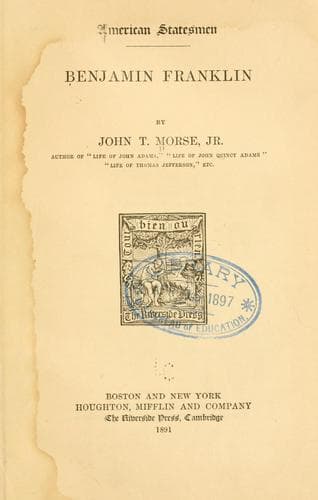
Benjamin FranklinMorse, John T., Jr. (John Torrey)
History
Benjamin Franklin
Morse, John T., Jr. (John Torrey)
Franklin, Benjamin, 1706-1790
Very exacting did the business of the American envoys soon become. On
December 23, 1776, they wrote to acquaint the Count de Vergennes that
they were "appointed and fully empowered by the Congress of the United
States of America to propose and negotiate a treaty of amity and
commerce between France and the United States;" and they requested an
audience for the purpose of presenting their credentials to his
excellency. Five days later the audience was given them. They explained
the desire of the American colonies to enter into a treaty of alliance
and of commerce. They said that the colonists were anxious to get their
ships, now lying at the home wharves laden with tobacco and other
products, out of the American harbors, and to give them a chance to run
for France. But the English vessels hovered thick up and down the
coasts, and the Americans, though able to take care of frigates, could
not encounter ships of the line. Would not France lend eight ships of
the line, equipped and manned, to let loose all this blockaded commerce
which was ready to seek her ports and to fill the coffers of her
merchants? Under all the circumstances this was certainly asking too
much; and in due time the envoys were courteously told so, but were also
offered a strictly secret loan of $400,000, to be repaid after the war,
without interest.
It appears that Franklin had substantially no concern in the quasi
commercial transactions pending at the time of his arrival between Deane
and Beaumarchais. Deane himself did not know and could not disclose the
details of the relationship between Beaumarchais and the government,
which indeed were not explored and made public until more than half a
century had elapsed after their occurrence. Therefore Franklin saw
nothing more than mercantile dealings in various stages of forwardness,
whose extensive intricacies it did not seem worth while for him to
unravel at a cost of much time and labor, which could be better expended
in other occupations.[41] Deane held all the threads, and it seemed
natural and proper to leave this business as his department. So Franklin
never had more than a general knowledge concerning this imbroglio.
Public-domain text, read in full here on John Shaqi.
Reviews
Reviews
No reviews yet
Be the first to share your thoughts on this work.
Elsewhere in the archive
Join the Discussion
Join the discussion
Sign in to leave a comment or review.
Sign InorCreate an account