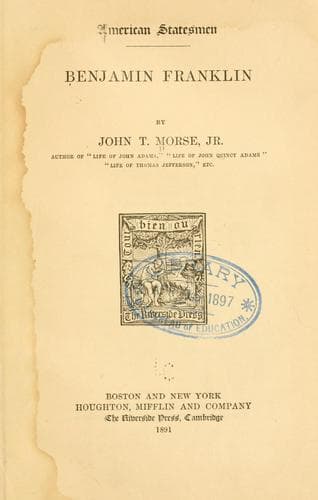
Benjamin FranklinMorse, John T., Jr. (John Torrey)
History
Benjamin Franklin
Morse, John T., Jr. (John Torrey)
Franklin, Benjamin, 1706-1790
Under flags of truce two cargoes of English sailors were dispatched from
Boston to England; but the English refused to reciprocate. "There is no
getting anything from these barbarians," said Franklin, "by advances of
civility or humanity." Then much trouble arose because the French
borrowed from Franklin some English prisoners for exchange in Holland,
and returned to him a like number a little too late for delivery on
board the cartel ship, which had brought over one hundred Americans.
Thereupon the Englishmen charged Franklin with "breach of faith," and
with "deceiving the Board," and put a stop to further exchanging. This
matter was, of course, set right in time. But the next point made by the
admiralty was that they would make no exchanges with Franklin except for
English sailors taken by American cruisers, thus excluding captives
taken by the privateersmen. Franklin, much angered at the thwarting of
his humane and reasonable scheme, said that they had "given up all
pretensions to equity and honor." In his disappointment he went a little
too far; if he had said "liberality and humanity" instead of "equity and
honor" he would have kept within literal truth. To meet this last action
on the part of England he suggested to Congress: "Whether it may not be
well to set apart 500 or 600 English prisoners, and refuse them all
exchange in America, but for our countrymen now confined in England?"
Another thing which vexed him later was that the English government
would not give the Americans an "equal allowance" with the French and
Spanish prisoners. He suggested retaliation upon a certain number of
English prisoners in America. He himself was constantly remitting money
to be distributed to the American prisoners, at the rate of one shilling
apiece each week. But he had the pain to hear that the wretched fellow,
one Digges, to whom he sent the funds, embezzled much of them. "If such
a fellow is not damned," he said, "it is not worth while to keep a
devil." One prisoner of distinction, Colonel Laurens, captured on his
way to France, complained that Franklin did not show sufficient zeal in
his behalf. But he made the assertion in ignorance of Franklin's
efforts, which for a long while Franklin had reason to believe had been
successful in securing kind and liberal treatment for this captive.
Public-domain text, read in full here on John Shaqi.
Reviews
Reviews
No reviews yet
Be the first to share your thoughts on this work.
Elsewhere in the archive
Join the Discussion
Join the discussion
Sign in to leave a comment or review.
Sign InorCreate an account