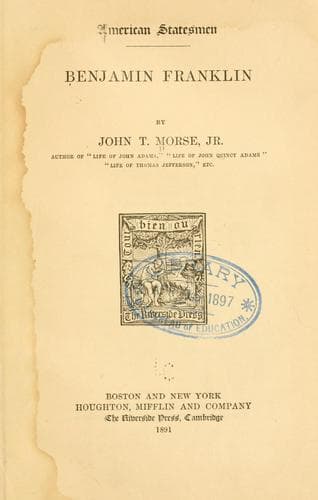
Benjamin FranklinMorse, John T., Jr. (John Torrey)
History
Benjamin Franklin
Morse, John T., Jr. (John Torrey)
Franklin, Benjamin, 1706-1790
insulting behavior to an old man and the senior commissioner; but
Franklin wisely said not a word, and added his signature to those of his
colleagues. The rest of the story is the familiar one of many cases: the
agent made repeated demands for the appointment of an accountant to
examine his accounts, and Franklin often and very urgently preferred the
same request. But the busy Congress would not bother itself ever so
little with a matter no longer of any practical moment. Lee's charges
remained unrefuted, though not a shadow of justifiable suspicion rested
upon Franklin's unfortunate nephew.
CHAPTER XI
MINISTER TO FRANCE, III TREATY WITH FRANCE: MORE QUARRELS
The enthusiastic reception of Franklin in France was responded to by him
with a bearing so cheerful and words so encouraging that all the
auguries for America seemed for a while of the best. For he was sanguine
by nature, by resolution, and by policy; and his way of alluring good
fortune was to welcome it in advance. But in fact there were clouds
enough floating in the sky, and soon they expanded and obscured the
transitory brightness. Communication between the two continents was
extremely slow; throughout the war intervals occurred when for long and
weary months no more trustworthy news reached Paris than the rumors
which got their coloring by filtration through Great Britain. Thus in
the dread year of 1777, there traveled across the Channel tales that
Washington was conducting the remnant of his forces in a demoralized
retreat; that Philadelphia had fallen before Howe; that Burgoyne, with a
fine army, was moving to bisect the insurgent colonies from the north.
It was very well for Franklin, when told that Howe had taken
Philadelphia, to reply: "No, sir: Philadelphia has taken Howe." The
jest may have relieved the stress of his mind, as President Lincoln used
often to relieve his own over-taxed endurance in the same way. But the
undeniable truth was that it looked much as if the affair, to use
Franklin's words, would prove to be a "rebellion" and not a
"revolution." Still, any misgivings which he may have inwardly felt
found no expression, and to no one would he admit the possibility of
such an ultimate outcome. Late in the autumn of this dismal year he
wrote:--
"You desire to know my opinion of what will probably be the end of
this war, and whether our new establishments will not be thereby
again reduced to deserts. I do not, for my part, apprehend much
danger of so great an evil to us. I think we shall be able, with a
little help, to defend ourselves, our possessions, and our
liberties so long that England will be ruined by persisting in the
wicked attempt to destroy them.... And I sometimes flatter myself
that, old as I am, I may possibly live to see my country settled in
peace, when Britain shall make no more a formidable figure among
the powers of Europe."
Public-domain text, read in full here on John Shaqi.
Reviews
Reviews
No reviews yet
Be the first to share your thoughts on this work.
Elsewhere in the archive
Join the Discussion
Join the discussion
Sign in to leave a comment or review.
Sign InorCreate an account