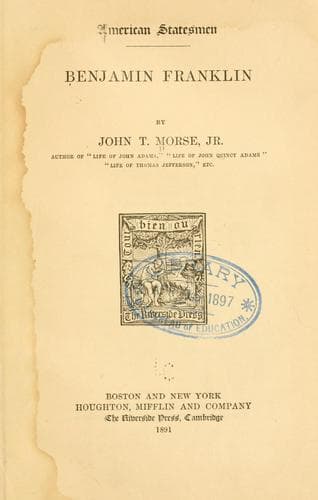
Benjamin FranklinMorse, John T., Jr. (John Torrey)
History
Benjamin Franklin
Morse, John T., Jr. (John Torrey)
Franklin, Benjamin, 1706-1790
It was not until December 4, 1777, that there broke a great and sudden
rift in the solid cloudiness. First there came a vague rumor of good
news, no one at all knew what; then a post-chaise drove into Dr.
Franklin's courtyard, and from it hastily alighted the young messenger,
Jonathan Loring Austin, whom Congress had sent express from
Philadelphia, and who had accomplished an extraordinarily rapid journey.
The American group of envoys and agents were all there, gathered by the
mysterious report which had reached them, and at the sound of the wheels
they ran out into the courtyard and eagerly surrounded the chaise.
"Sir," exclaimed Franklin, "is Philadelphia taken?" "Yes, sir," replied
Austin; and Franklin clasped his hands and turned to reenter the house.
But Austin cried that he bore greater news: that General Burgoyne and
his whole army were prisoners of war! At the words the glorious sunshine
burst forth. Beaumarchais, the ecstatic, sprang into his carriage and
drove madly for the city to spread the story; but he upset his vehicle
and dislocated his arm. The envoys hastily read and wrote; in a few
hours Austin was again on the road, this time bound to de Vergennes at
Versailles, to tell the great tidings. Soon all Paris got the news and
burst into triumphant rejoicing over the disaster to England.
Austin's next errand was a secret and singular one. Franklin managed
throughout his residence in France to maintain a constant communication
with the opposition party in England. He now thought it wise to enable
them to obtain full information from an intelligent man who was not many
weeks absent from the States. Accordingly he dispatched Austin, using
extreme precautions of secrecy, making him "burn every letter which he
had brought from his friends in America," but giving him in exchange two
other letters, which certainly introduced him to strange society for an
American "rebel" to frequent. During his visit he was "domesticated in
the family of the Earl of Shelburne; placed under the particular
protection of his chaplain, the celebrated Dr. Priestley; introduced" to
George IV., then Prince of Wales, with whom was Charles Fox, and was
"present at all the coteries of the opposition." Almost every evening he
was invited to dinner-parties, at which the company was chiefly composed
of members of Parliament, and they plied him with interrogations about
his country and its affairs, so that, as he reported, "no question which
you can conceive is omitted."[49] He answered well, and rendered
service as good as it was singular, for which Franklin was probably the
only American who could have furnished the opening. The adventure brings
to mind some of the Jacobite tales of Sir Walter Scott's novels.
[Note 49: Parton's _Life of Franklin_, ii. 307.]
Public-domain text, read in full here on John Shaqi.
Reviews
Reviews
No reviews yet
Be the first to share your thoughts on this work.
Elsewhere in the archive
Join the Discussion
Join the discussion
Sign in to leave a comment or review.
Sign InorCreate an account