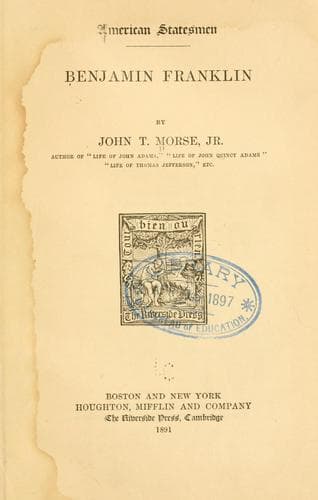
Benjamin FranklinMorse, John T., Jr. (John Torrey)
History
Benjamin Franklin
Morse, John T., Jr. (John Torrey)
Franklin, Benjamin, 1706-1790
Hartley's advice, if not acceptable, was at least timely. At the very
moment when he warned America against taking refuge in the arms of
France, the colonists were joyously springing into that international
embrace. The victory at Saratoga had at last settled that matter. On
December 6, 1777, two days after the news was received, M. Gerard called
upon the envoys and said that the capacity of the colonies to maintain
their independence could no longer be doubted, and that the French court
would be pleased by a renewal of their proposals for an alliance. On
December 8 a request for an alliance was placed by young Temple Franklin
in the hands of de Vergennes. On December 12 the cabinet met; also
Arthur Lee reports that the envoys went out to Versailles and concealed
themselves at an appointed spot in the wood, whither soon came to them
de Vergennes. In the talk that ensued he said to them everything which a
liberal spirit of friendship could suggest, but nothing which was
actually positive and binding. For it was necessary, as he explained,
first to consult with Spain, whose concurrence was desired; this,
however, could be safely counted upon, and a courier was to be
dispatched at once to Madrid. But the return of this messenger was not
awaited; for on December 17 the commissioners were formally notified
that France would acknowledge the independence of the colonies, and
would execute with them treaties of commerce and alliance immediately
upon getting the Spanish reply. In return for her engagements France
only asked that, in the probable event of a war ensuing between herself
and England, the colonies would pledge themselves never to make peace
save upon the terms of independence.
On January 8, 1778, M. Gerard met the envoys after dark at Mr. Deane's
quarters. He informed them that the government had resolved immediately
to conclude with the colonies a treaty of amity and commerce; also
another treaty, offensive and defensive, and guaranteeing independence,
upon the conditions that the colonies would neither make a separate
peace, nor one relinquishing their independence. The independence of the
thirteen colonies being the king's sole purpose, no assistance would be
extended for subduing Canada or the English West Indies. As it would
probably not be agreeable to the colonies to have foreign troops in
their country, the design was to furnish only naval aid. It would be
left open for Spain to accede to the treaties at any time. Nothing could
have been more agreeable and encouraging than these arrangements, by
which France did all the giving and America all the receiving. A few
days later Gerard said that the king would not only acknowledge, but
would support American independence, and that the condition precluding
the Americans from making a separate peace, if France should be drawn
into the war, would be waived.
Public-domain text, read in full here on John Shaqi.
Reviews
Reviews
No reviews yet
Be the first to share your thoughts on this work.
Elsewhere in the archive
Join the Discussion
Join the discussion
Sign in to leave a comment or review.
Sign InorCreate an account