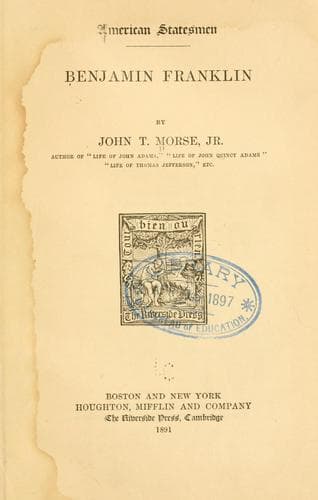
Benjamin FranklinMorse, John T., Jr. (John Torrey)
History
Benjamin Franklin
Morse, John T., Jr. (John Torrey)
Franklin, Benjamin, 1706-1790
Thus far the course of France throughout her relationship with the
States had been that of a generous friend. She undoubtedly had been
primarily instigated by enmity to England; and she had been for a while
guarded and cautious; yet not unreasonably so; on the contrary, she had
in many instances been sufficiently remiss in regarding her neutral
obligations to give abundant cause for war, though England had not felt
ready to declare it. At the first interview concerning the treaty of
commerce de Vergennes had said that the French court desired to take no
advantage of the condition of the States, and to exact no terms which
they would afterward regret, but rather to make an arrangement so based
upon the interest of both parties that it should last as long as human
institutions should endure, so that mutual amity should subsist forever.
M. Gerard reiterated the same sentiments. That this language was not
mere French courtesy was proved by the fact that the treaties, when
completed, were "founded on principles of equality and reciprocity, and
for the most part were in conformity to the proposals of Congress."[57]
Each party, under the customs laws of the other, was to be upon the
footing of the most favored nation. The transfer of the valuable and
growing trade of the States from England to France had been assiduously
held out as a temptation to France to enter into these treaties; but no
effort was made by France to gain from the needs of the Americans any
exclusive privileges for herself. She was content to stipulate only that
no other people should be granted preferences over her, leaving the
States entirely unhampered for making subsequent arrangements with other
nations. The light in which these dealings about the treaties made the
French minister and the French court appear to Franklin should be
remembered in the discussions which arose later concerning the treaty of
peace.[58]
[Note 57: Bancroft, _Hist. U. S._ ix. 481.]
[Note 58: See Franklin's _Works_, vi. 133. At this time John Adams
strongly entertained the same sentiments, though he afterward felt very
differently about the sincerity of France. _Diplomatic Correspondence of
American Revolution_, iv. 262, 292.]
Public-domain text, read in full here on John Shaqi.
Reviews
Reviews
No reviews yet
Be the first to share your thoughts on this work.
Elsewhere in the archive
Join the Discussion
Join the discussion
Sign in to leave a comment or review.
Sign InorCreate an account