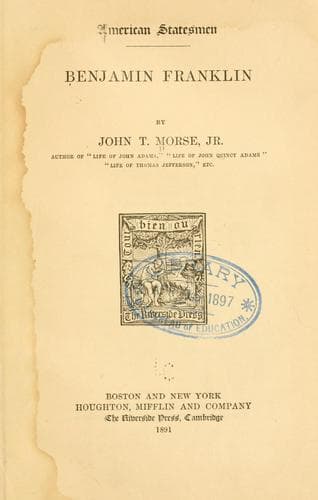
Benjamin FranklinMorse, John T., Jr. (John Torrey)
History
Benjamin Franklin
Morse, John T., Jr. (John Torrey)
Franklin, Benjamin, 1706-1790
[Note 60: Franklin's _Works_, vi. 153.]
Mr. Hale in his recent volumes upon Franklin truly says that "it is
unnecessary to place vituperative adjectives to the credit [discredit?]
of Arthur Lee;" and in fact to do so seems a work of supererogation,
since there probably remain few such epithets in the English language
which have not already been applied to him by one writer or another. Yet
it is hard to hold one's hand, although humanity would perhaps induce us
to pity rather than to revile a man cursed with so unhappy a
temperament. But whatever may be said or left unsaid about him
personally, the infinite disturbance which he caused cannot be wholly
ignored. It was great enough to constitute an important element in
history. Covered by the powerful authority of his influential and
patriotic family at home, and screened by the profound ignorance of
Congress concerning men and affairs abroad, Lee was able for a long time
to run his mischievous career without discovery or interruption. He
buzzed about Europe like an angry hornet, thrusting his venomous sting
into every respectable and useful servant of his country, and irritating
exceedingly the foreigners whom it was of the first importance to
conciliate. Incredible as it seems, it is undoubtedly true that he did
not hesitate to express in Paris his deep antipathy to France and
Frenchmen; and it was only the low esteem in which he was held that
prevented his singular behavior from doing irreparable injury to the
colonial cause. The English newspapers tauntingly ridiculed his
insignificance and incapacity; de Vergennes could not endure him, and
scarcely treated him with civility. But his intense egotism prevented
him from gathering wisdom from such harsh instruction, which only added
gall to his native bitterness. He wreaked his revenge upon his
colleagues, and towards Franklin he cherished an envious hatred which
developed into a monomania. Perhaps Franklin was correct in charitably
saying that at times he was "insane." He began by asserting that
Franklin was old, idle, and useless, fit only to be shelved in some
respectable sinecure mission; but he rapidly advanced from such moderate
condemnation until he charged Franklin with being a party to the
abstraction of his dispatches from a sealed parcel, which was rifled in
some unexplained way on its passage home;[61] and finally he even
reached the extremity of alleging financial dishonesty in the public
business, and insinuated an opinion that the doctor's great rascality
indicated an intention never again to revisit his native land. In all
this malevolence he found an earnest colleague in the hot-blooded Izard,
whose charges against Franklin were unmeasured. "His abilities," wrote
this angry gentleman, "are great and his reputation high. Removed as he
is at so considerable a distance from the observation of his
constituents, if he is not guided by principles of virtue and honor,
Public-domain text, read in full here on John Shaqi.
Reviews
Reviews
No reviews yet
Be the first to share your thoughts on this work.
Elsewhere in the archive
Join the Discussion
Join the discussion
Sign in to leave a comment or review.
Sign InorCreate an account