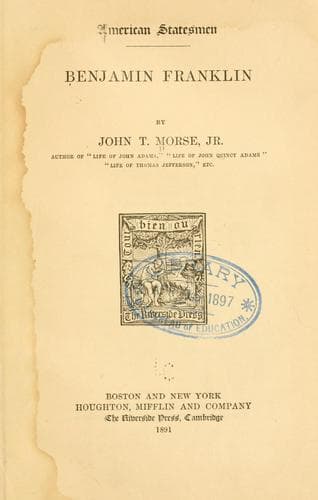
Benjamin FranklinMorse, John T., Jr. (John Torrey)
History
Benjamin Franklin
Morse, John T., Jr. (John Torrey)
Franklin, Benjamin, 1706-1790
Shortly after his appointment Franklin sent his grandson to Lee, with a
note requesting Lee to send to him such papers belonging to the embassy
as were in his possession. Lee insolently replied that he had "no papers
belonging to the department of minister plenipotentiary at the court of
Versailles;" that if Franklin referred to papers relating to
transactions of the late joint commission, he had "yet to learn and
could not conceive" by what reason or authority one commissioner was
entitled to demand custody of them. Franklin replied temperately enough
that many of them were essential to him for reference in conducting the
public business, but said that he should be perfectly content to have
copies. The captious Lee was still further irritated by this scheme for
avoiding a quarrel, but had to accede to it.
***
To John Paul Jones Franklin stood in the relation of a navy department.
The daring exploits of that gallant mariner form a chapter too
fascinating to be passed by without reluctance, but limitations of space
are inexorable. His success and his immunity in his reckless feats seem
marvelous. His chosen field was the narrow seas which surround Britain,
which swarmed with British shipping, and were dominated by the
redoubtable British navy as the streets of a city are kept in order by
police. But the rover Jones, though always close to his majesty's
coasts, was too much for all his majesty's admirals and captains. He
harried these home waters and captured prizes till he became embarrassed
by the extent of his own success; he landed at Whitehaven, spiked the
guns of the fort, and fired the ships of the fleet in the harbor beneath
the eyes of the astounded Englishmen, who thronged the shore and gazed
bewildered upon the spectacle which American audacity displayed for
them; he made incursions on the land; he threatened the port of Leith,
and would undoubtedly have bombarded it, had not obstinate counter winds
thwarted his plans; he kept the whole British shores in a state of
feverish alarm; he was always ready to fight, and challenged the
English warship, the Serapis, to come out and meet him; she came, and he
captured her after fighting so desperately that his own ship, the famous
Bon Homme Richard, named after Poor Richard, sank a few hours after the
combat was over.
[Illustration]
Public-domain text, read in full here on John Shaqi.
Reviews
Reviews
No reviews yet
Be the first to share your thoughts on this work.
Elsewhere in the archive
Join the Discussion
Join the discussion
Sign in to leave a comment or review.
Sign InorCreate an account