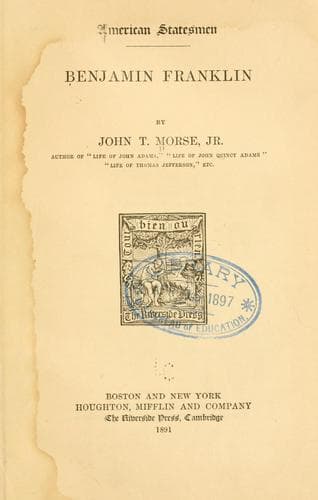
Benjamin FranklinMorse, John T., Jr. (John Torrey)
History
Benjamin Franklin
Morse, John T., Jr. (John Torrey)
Franklin, Benjamin, 1706-1790
He now engaged to pay all the drafts which Jay should send to him, so
that Jay could extricate himself honorably from those dread engagements
which had been giving that harassed gentleman infinite anxiety at
Madrid. Some of his acceptances had already gone to protest; but
Franklin soon took them all up. By the end of March he began to breathe
more freely; he had saved himself and his colleagues thus far and now he
hoped that the worst was over. He wrote to Morris: "Your promise that
after this month no more bills shall be drawn on me keeps up my spirits
and affords me the greatest satisfaction." By the following summer the
accounts between France and the States were in course of liquidation,
and Franklin called the attention of Livingston to the fact that the
king practically made the States a further present "to the value of near
two millions. These, added to the free gifts before made to us at
different times, form an object of at least twelve millions, for which
no returns but that of gratitude and friendship are expected. These, I
hope, may be everlasting." But liquidation, though a necessary
preliminary to payment, is not payment, and does not preclude a
continuance of borrowing; and in August we find that Morris was still
pressing for more money, still drawing drafts, in happy forgetfulness of
his promises not to do so, and still keeping Franklin in anxious dread
of bankruptcy. By the same letter it appears that Morris had directed
Franklin to pay over to M. Grand, the banker, any surplus funds in his
hands! "I would do it with pleasure, if there were any such," said
Franklin; but the question was still of a deficit, not of a surplus.
December 14, 1782, finds Franklin still at the old task, preferring "the
application so strongly pressed by the Congress for a loan of
$4,000,000." Lafayette again helped him, but the result remained
uncertain. The negotiations for peace were so far advanced that the
ministers thought it time for such demands to cease. But probably he
succeeded, for a few days later he appears to be remitting a
considerable sum. Peace, however, was at hand, and in one respect at
least it was peace for Franklin as well as for his country, for even
Congress could no longer expect him to continue borrowing. He had indeed
rendered services not less gallant though less picturesque than those of
Washington himself, vastly more disagreeable, and scarcely less
essential to the success of the cause.
CHAPTER XIII
HABITS OF LIFE AND OF BUSINESS: AN ADAMS INCIDENT
Public-domain text, read in full here on John Shaqi.
Reviews
Reviews
No reviews yet
Be the first to share your thoughts on this work.
Elsewhere in the archive
Join the Discussion
Join the discussion
Sign in to leave a comment or review.
Sign InorCreate an account