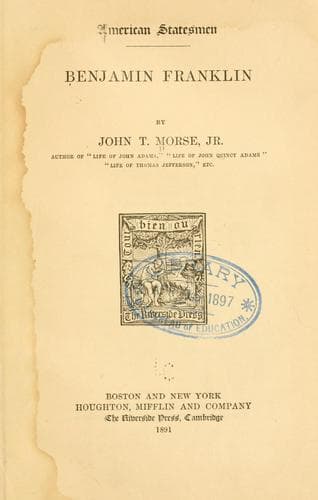
Benjamin FranklinMorse, John T., Jr. (John Torrey)
History
Benjamin Franklin
Morse, John T., Jr. (John Torrey)
Franklin, Benjamin, 1706-1790
In his shrewd, intelligent fashion, Franklin was watching these events,
perfectly appreciating the significance of each in turn. On March 22 he
seized an opportunity which chance threw in his way for writing to Lord
Shelburne a short note, in which he suggested a hope that the
"returning good disposition" of England towards America would "tend to
produce a general peace." It was a note of a few lines only, seemingly a
mere pleasant passage of courtesy to an old friend, but significant and
timely, an admirable specimen of the delicate tact with which Franklin
could meet and almost create opportunity. A few days later the cabinet
of Lord Rockingham was formed, composed of the friends of America. In it
Charles Fox was secretary for foreign affairs, and Lord Shelburne had
the home department, including the colonies. No sooner were the new
ministers fairly instated than Shelburne dispatched Richard Oswald, a
retired Scotch merchant, of very estimable character, of good temper,
reasonable views, and sufficient ability, to talk matters over with
Franklin at Paris. Oswald arrived on April 12, and had satisfactory
interviews with Franklin and de Vergennes. The important fact of which
he became satisfied by the explicit language of Franklin was, that the
hope of inducing the American commissioners to treat secretly and
separately from France was utterly groundless.[80] After a few days he
went back to London, carrying a letter from Franklin to Shelburne, in
which Franklin expressed his gratification at these overtures and his
hope that Oswald might continue to represent the English minister.
Oswald also carried certain "Notes for Conversation," which Franklin had
written out; "some loose thoughts on paper," as he called them, "which I
intended to serve as memorandums for my discourse, but without a fixed
intention of showing them to him." As matters turned out later, it would
have been better if Franklin had not been quite so free with these
"memorandums," which contained a suggestion that the English should cede
Canada and the Americans should recoup the losses of the royalists.
Indeed, no sooner had the paper left his hands than he saw his error,
and was "a little ashamed of his weakness." The letter only was shown to
the whole cabinet.
[Note 80: About the same time Laurens was released on parole and
sent to confer with Adams in Holland, concerning a separate treating,
and brought from Adams the like response as Oswald brought from
Franklin.]
Public-domain text, read in full here on John Shaqi.
Reviews
Reviews
No reviews yet
Be the first to share your thoughts on this work.
Elsewhere in the archive
Join the Discussion
Join the discussion
Sign in to leave a comment or review.
Sign InorCreate an account