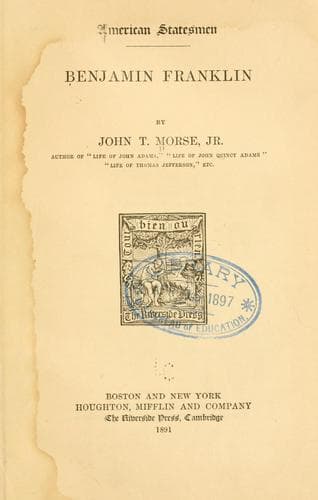
Benjamin FranklinMorse, John T., Jr. (John Torrey)
History
Benjamin Franklin
Morse, John T., Jr. (John Torrey)
Franklin, Benjamin, 1706-1790
No sooner were the preliminary or provisional articles signed than
Franklin informed de Vergennes of the fact. That minister was much
surprised. He had been quietly biding his time, expecting to be invoked
when the English and the Americans should find themselves stopped by
that deadlock which he had done his best to bring about by his secret
intimations to England. He was now astonished to learn that England had
not availed herself of his astute suggestions, but had given terms which
the Americans had gladly accepted. The business was all done, and the
clever diplomat had not had his chance. At first he said nothing, but
for a few days pondered the matter. Then on December 15 he disburdened
his mind in a very sharp letter to Franklin. "I am at a loss," he
wrote, "to explain your conduct and that of your colleagues on this
occasion. You have concluded your preliminary articles without any
communication between us, although the instructions from Congress
prescribe that nothing shall be done without the participation of the
king. You are about to hold out a certain hope of peace to America,
without even informing yourself of the state of the negotiation on our
part. You are wise and discreet, sir; you perfectly understand what is
due to propriety; you have all your life performed your duties; I pray
you consider how you propose to fulfill those which are due to the
king."
Franklin found himself in a painful position; for he could by no means
deny that he had duties, or at least something very near akin to duties,
to the king, imposed upon him by numerous and weighty obligations which
at his request had been conferred upon him and accepted by him on behalf
of the American people. The violation of the instructions of Congress
gave to the secret treating too much the air of an insulting distrust,
of the throwing over a friend when he had been sufficiently used; for
whatever might be suspected, it could by no means be proved that de
Vergennes was not still the sincere friend which he certainly long had
been. This bore hard upon Franklin. The policy which in fact had been
forced upon him against his will by his colleagues was now made a
matter of personal reproach against him especially, because he was
persistently regarded as the head and front of the commission; no
European yet dreamed of considering any other American as of much
consequence in any matter in which Franklin was concerned. During long
years de Vergennes had been his constant and efficient adviser and
assistant in many a day of trial and of stress, and Franklin believed
him to be still an honest well-wisher to the States. Moreover it
actually was only a very few weeks since Franklin had applied for and
obtained a new loan at a time when the king was so pressed for his own
needs that a lottery was projected, and bills drawn by his own officials
were going to protest. All this made the secrecy which had been
practiced seem almost like duplicity on Franklin's part, and he felt
Public-domain text, read in full here on John Shaqi.
Reviews
Reviews
No reviews yet
Be the first to share your thoughts on this work.
Elsewhere in the archive
Join the Discussion
Join the discussion
Sign in to leave a comment or review.
Sign InorCreate an account