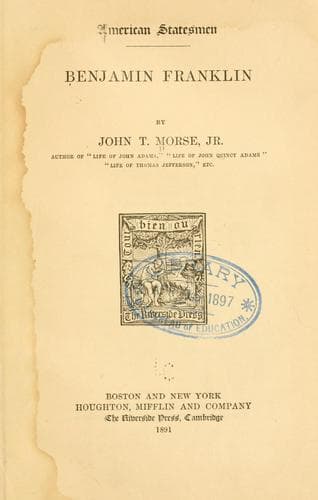
Benjamin FranklinMorse, John T., Jr. (John Torrey)
History
Benjamin Franklin
Morse, John T., Jr. (John Torrey)
Franklin, Benjamin, 1706-1790
great effect of his testimony, 121;
presents American sentiment against the Stamp Act, 122;
expresses willingness to sacrifice all rather than submit, 123, 124;
states legislative independence of colonies, 124, 125;
has friendly feeling for George III., 126;
seeks to defend him, 126, 127;
thinks colonial representation in Parliament impossible of adoption, 128;
views on "virtual" representation, 130;
draws distinctions between external and internal taxation, 130, 131;
asserts willingness of colonies to bear their share of public burdens, 132;
return of popularity in Pennsylvania, 134;
satirical publications at expense of
English ignorance of colonies, 134, 135;
joke concerning a claim of the king of Prussia to England, 136;
"rules for reducing a great empire to a small one," 136;
communications with the French, 137;
appointed agent for Georgia and Massachusetts, 138;
opposed by Samuel Adams, 138;
increased prestige, 139;
pecuniary sacrifice, 139;
retains post-mastership, 140;
motives of ministry in leaving him undisturbed, 140;
rumors circulated in America that he had accepted royal office, 141;
his reputation increases in England and France, 144;
urges moderation at home, 145;
disliked by extremists, 146;
hopes advantage from Hillsborough's appointment, 151;
discovers Hillsborough's enmity, 152;
dispute with him over legality of commission from Massachusetts, 152-157;
a telling retort, 157;
no longer recognized as agent of Massachusetts, 157;
low opinion of Hillsborough, 158;
thinks agents quite as valuable to government as to colonies, 158;
works to undermine Hillsborough, 159, 160;
controverts Hillsborough's objections to two frontier colonies, 162;
his arguments prevail with the privy council, 163;
drives Hillsborough to resign, 163;
snubbed by him, 164;
fails to get the grant for frontier provinces, 164;
suggests Lord Dartmouth for colonial secretary, 165;
amicable relations with him, 166;
counsels him to be patient with Massachusetts, 167, 168;
would be satisfied with a return to conditions before Stamp Act, 169;
begins to forbode separation, but hopes and works for peace, 171;
continually urges moderation on colonists, 172;
belief in efficacy of non-importation, 173;
urges its advantages, 173;
and effects upon England, 174;
comments on complete financial failure of Stamp Act and Customs Act, 176;
shown copies of Tory letters from Massachusetts, 177;
sends them to Boston under pledge of secrecy, 178;
publishes a letter taking upon himself
responsibility of their discovery, 182, 183;
presents petition of Massachusetts to Dartmouth, 183;
delicacy of his position, 184;
learns that Hutchinson and Oliver are to be represented by counsel, 185;
fearing trouble and foreseeing an attack, asks for time, 186;
threats and rumors, 187;
appears before a hostile privy council, 187, 188;
Public-domain text, read in full here on John Shaqi.
Reviews
Reviews
No reviews yet
Be the first to share your thoughts on this work.
Elsewhere in the archive
Join the Discussion
Join the discussion
Sign in to leave a comment or review.
Sign InorCreate an account