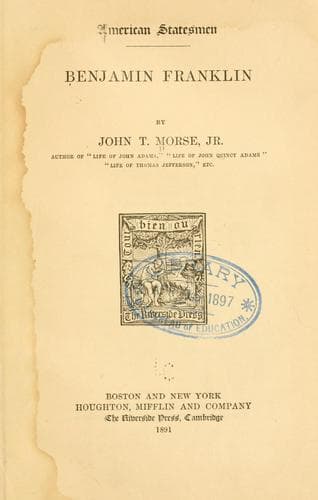
Benjamin FranklinMorse, John T., Jr. (John Torrey)
History
Benjamin Franklin
Morse, John T., Jr. (John Torrey)
Franklin, Benjamin, 1706-1790
desire to wreak injury upon Franklin became such a passion as caused him
in certain instances to forget all principles of honor, to say nothing
of honesty.
CHAPTER VI
SECOND MISSION TO ENGLAND, II
In order to continue the narrative of events with due regard to
chronological order it is necessary to revert to the repeal of the Stamp
Act. The repealing act was fully as unpopular in England as the repealed
act had been in America. It was brought about by no sense of justice, by
no good will toward the colonists, but solely by reason of the injury
which the law was causing in England, and which was forced upon the
reluctant consideration of Parliament by the urgent clamor of the
suffering merchants; also perhaps in some degree by a disinclination to
send an army across the Atlantic, and by the awkward difficulty
suggested by Franklin when he said that if troops should be sent they
would find no rebellion, no definite form of resistance, against which
they could act. The repeal, therefore, though carried by a large
majority, was by no means to be construed as an acknowledgment of error
in an asserted principle, but only as an unavoidable admission of a
mistake in the application of that principle. The repealing majority
grew out of a strange coalition of men of the most opposite ways of
thinking concerning the fundamental question. For example, Charles
Townshend was a repealer, yet all England did not hold a man who was
more wedded than was Townshend to the idea of levying internal taxes in
the colonies by act of Parliament. The notion had been his own
mischievous legacy to Grenville, but he now felt that it had been
clumsily used by his legatee. Many men agreed with him, and the
prevalence of this opinion was made obvious by the passage, almost
simultaneously, of the resolution declaratory of the right of
parliamentary taxation. But the solace of an empty assertion was wholly
inadequate to heal the deep wound which English pride had received. The
great nation had been fairly hounded into receding before the angry
resistance of a parcel of provincials dwelling far away across the sea;
the recession was not felt to be an act of magnanimity or generosity or
even of justice, but only a bitter humiliation and indignity. Poor
Grenville, the responsible adviser of the blundering and unfortunate
measure, lost almost as much prestige as Franklin gained. It was hard
luck for him; he was as honest in his convictions as Franklin was in the
opposite faith, and he was a far abler minister than the successor
charged to undo his work. But his knowledge of colonial facts was very
insufficient, and the light in which he viewed them was hopelessly
false. Franklin had a knowledge immeasurably greater, and was almost
incapable of an error of judgment; of all the reputation which was won
or lost in this famous contest he gathered the lion's share; he was the
hero of the colonists; his ability was recognized impartially by both
Public-domain text, read in full here on John Shaqi.
Reviews
Reviews
No reviews yet
Be the first to share your thoughts on this work.
Elsewhere in the archive
Join the Discussion
Join the discussion
Sign in to leave a comment or review.
Sign InorCreate an account