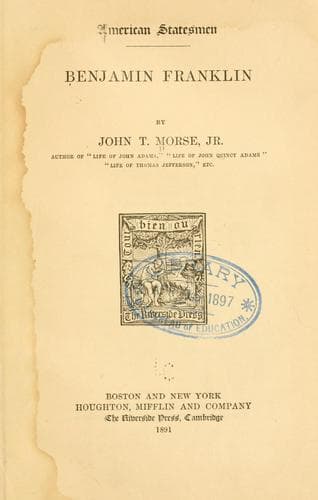
Benjamin FranklinMorse, John T., Jr. (John Torrey)
History
Benjamin Franklin
Morse, John T., Jr. (John Torrey)
Franklin, Benjamin, 1706-1790
universal moderation in language and behavior, could avail comparatively
little so long as Townshend, whom Pitt used to call "the incurable,"
could threaten and bring in obnoxious revenue measures.
Shelburne had the backing of Pitt; but, by ill luck, so soon as the
cabinet was formed, Pitt ceased to be Pitt, and became the Earl of
Chatham; and with the loss of his own name he lost also more than half
of his power. Moreover the increasing infirmities of his body robbed him
of efficiency and impaired his judgment. He was utterly unable to keep
in subordination his reckless chancellor of the exchequer, betwixt whom
and himself no good will had ever existed. On the other hand, this
irrepressible Townshend had a far better ally in George III., who
sympathized in his purposes, gave him assistance which was none the less
powerful for being indirect and occult, and who hated and ingeniously
thwarted Shelburne. Moreover, as has been said, it was a popular
delusion that Townshend had exceptionally full and accurate knowledge
concerning American affairs. His self-confident air, making assurance of
success, won for him one half of the battle by so sure a presage of
victory. He lured the members of the House by showing them a
considerable remission in their own taxes, provided they would stand by
his scheme of replacing the deficit by an income from the colonies; and
he boldly assured his delighted auditors that he knew "the mode by which
a revenue could be drawn from America without offense." He was of the
thoughtless class which learns no lesson. He still avowed himself "a
firm advocate of the Stamp Act," and with cheerful scorn he "laughed at
the absurd distinction between internal and external taxes." He did not
expect, he merrily said, alluding to the distinction just conferred upon
Chatham, to have _his_ statue erected in America. The reports of his
speeches kept the colonial mind disquieted. The act requiring the
provinces in which regiments were quartered to provide barracks and
rations for the troops at the public expense was a further irritation.
Shelburne sought to make the burden as easy as possible, but Townshend
made Shelburne's duties as hard as possible. Of what use were the
minister's liberality and moderation, when the chancellor of the
exchequer evoked alarm and wrath by announcing insolently that he was
for governing the Americans as subjects of Great Britain, and for
restraining their trade and manufactures in subordination to those of
the mother country! So the struggle went on within the ministry as well
as without it; but the opponents of royal prejudice were heavily
handicapped; for the king, though stupid in general, had some political
skill and much authority. His ill-concealed personal hostility to his
"enemy," as he called Shelburne, threatened like the little cloud in
the colonial horizon. Nor was it long before Chatham, a dispirited
wreck, withdrew himself entirely from all active participation in
Public-domain text, read in full here on John Shaqi.
Reviews
Reviews
No reviews yet
Be the first to share your thoughts on this work.
Elsewhere in the archive
Join the Discussion
Join the discussion
Sign in to leave a comment or review.
Sign InorCreate an account