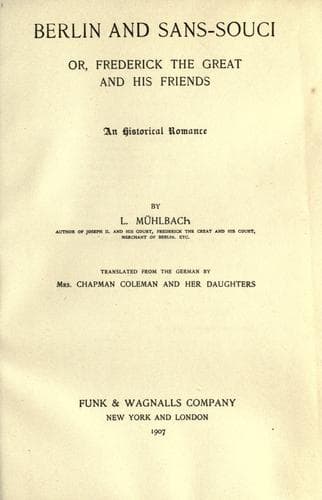
Berlin and Sans-Souci; Or, Frederick the Great and His FriendsMühlbach, L. (Luise)
History
Berlin and Sans-Souci; Or, Frederick the Great and His Friends
Mühlbach, L. (Luise)
Frederick II, King of Prussia, 1712-1786 -- Fiction; Prussia (Germany) -- History -- Frederick II, 1740-1786 -- Fiction
"Yes, that is true, but what will you have? There are many things in
this incomprehensible world which are poisonous, and which, for that
reason, are the more alluring. This is peculiarly so with women. He
does well who avoids them; they bewilder our reason and make our
hearts sick, but we do not flee from them. We pursue them, and the
poison which they infuse in our veins is sweet; we quaff it
rapturously, though death is in the cup."
"In this, however, your majesty is wiser than all other men: you
alone have the power to turn away from or withstand them."
"Who knows? perhaps that is sheer cowardice," said the king; he
turned away confused, and beat with his fingers upon the window-
glass. "I called the Rhine wine poison, because of its strength. I
think now that it alone deserves to be called wine--it is the only
wine which has bloom." Frederick was again silent, and beat a march
upon the window.
The general looked at him anxiously and thoughtfully; suddenly his
countenance cleared, and a half-suppressed smile played upon his
lips.
"I will allow myself to add a conclusive word to those of my king,
that is, a moral to his fable. Your majesty says Rhine wine is the
only wine which deserves the name, because it alone has bloom. So I
will call that society only society which is graced and adorned by
women. Women are the bloom of society. Do you not agree with me,
sire?"
"If I agree to that proposition, it amounts to a request that you
will invite women to our fete this evening--will it not?" said the
king, still thrumming on the window.
"And with what rapture would I fulfil your wish, but I fear it would
be difficult to induce the ladies to come to the house of a young
bachelor as I am!"
"Ah, bah! I have determined during the next winter to give these
little suppers very often. I will have a private table, and women
shall be present."
"Yes, but your majesty is married."
"They would come if I were a bachelor. The Countess Carnas, Frau von
Brandt, the Kleist, and the Morien, are too witty and too
intellectual to be restrained by narrow-minded prejudice."
"Does your majesty wish that I should invite these ladies?" said the
general; "they will come, without doubt, if your majesty commands
it. Shall I invite them?"
The king hesitated a moment to reply. "Perhaps they would not come
willingly," said he; "you are unmarried, and they might be afraid of
their husbands' anger."
"I must, then, invite ladies who are not married," said Rothenberg,
whose face was now radiant with delight; "but I do not know one
unmarried lady of the higher circles who carries her freedom from
prejudice so far as to dare attend a bachelor's supper."
"Must we always confine our invitations to the higher circles?" said
the king, beating his parade march still more violently upon the
window.
Rothenberg watched him with the eye of a sportsman, who sees the
wild deer brought to bay.
"If your majesty will condescend to set etiquette aside, I will make
a proposition."
Public-domain text, read in full here on John Shaqi.
Reviews
Reviews
No reviews yet
Be the first to share your thoughts on this work.
Elsewhere in the archive
Join the Discussion
Join the discussion
Sign in to leave a comment or review.
Sign InorCreate an account