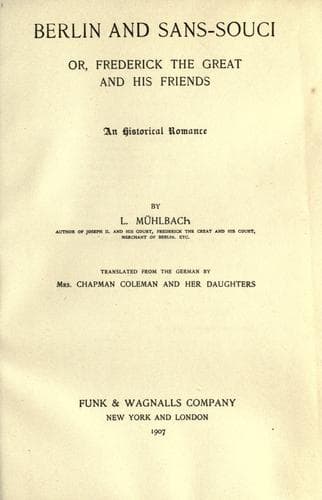
Berlin and Sans-Souci; Or, Frederick the Great and His FriendsMühlbach, L. (Luise)
History
Berlin and Sans-Souci; Or, Frederick the Great and His Friends
Mühlbach, L. (Luise)
Frederick II, King of Prussia, 1712-1786 -- Fiction; Prussia (Germany) -- History -- Frederick II, 1740-1786 -- Fiction
"You know, messieurs," said Frederick, "that Maria Theresa, who
calls herself Empress of Germany and of Rome, still makes war
against our ally Charles the Seventh. Her general, Karl von
Lothringen, has triumphed over the Bavarian and French army at
Semnach: and Bavaria, left, by the flight of the emperor, without a
leader, has been compelled to submit to Maria Theresa, Queen of
Hungary. She has allied herself with England, Hanover, and Saxony.
And these allied powers have been victorious over the army of our
ally, King Louis of France, commanded by Marshal Noailles. These
successes have made our enemies imperious. They have demanded much;
they have resolved to obtain all. Apparently they are the most
powerful. Holland has offered money and ships; Sardinia and Saxony
have just signed the treaty made at Worms by England, Austria, and
Holland. So they have troops, gold, and powerful allies. We have
nothing but our honor, our swords, and our good cause. We are the
allies of a land poor in itself, and, what is still worse, governed
by a weak and faint-hearted emperor; and of France, whose king is
the plaything of courtiers and mistresses. Our adversaries know
their strength, and are acquainted with our weakness. Look,
messieurs, at this letter of George of England to our godmother,
Maria Theresa of Hungary; an accident placed it in our hands, or, if
you will, a Providence, which, without doubt, watches over the
prosperity of Prussia. Read it, messieurs."
He handed General Rothenberg a paper, which he read with frowning
brow and scarcely suppressed scorn, and then passed it on to
Winterfeld. The king studied the face of every reader, and, the more
dark and stormy it appeared, the more gay and happy was the
expression of his countenance.
He received the letter again with a friendly smile from the hands of
his minister, and pointing to it with his finger, he said: "Have you
well considered these lines where the king says, 'Madame, what is
good to take, is also good to return'? What think you of these
words, Prince von Anhalt?"
"I think," said the silver-haired old warrior, "that we will prove
to the English king what Frederick of Prussia once holds cannot be
rescued from him."
"You think, then, that our hands are strong enough to hold our
possessions?"
"Yes, your majesty."
"And you, gentlemen?"
"We share the opinion of the prince."
Public-domain text, read in full here on John Shaqi.
Reviews
Reviews
No reviews yet
Be the first to share your thoughts on this work.
Elsewhere in the archive
Join the Discussion
Join the discussion
Sign in to leave a comment or review.
Sign InorCreate an account