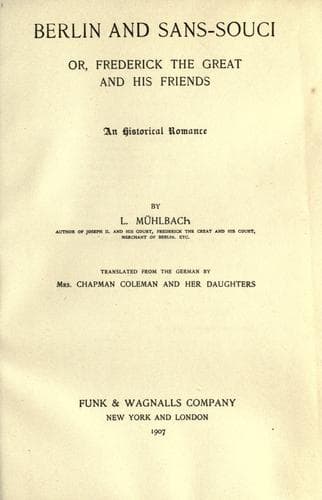
Berlin and Sans-Souci; Or, Frederick the Great and His FriendsMühlbach, L. (Luise)
History
Berlin and Sans-Souci; Or, Frederick the Great and His Friends
Mühlbach, L. (Luise)
Frederick II, King of Prussia, 1712-1786 -- Fiction; Prussia (Germany) -- History -- Frederick II, 1740-1786 -- Fiction
"How beautiful is the world!" said one, folding his hands piously,
and gazing up into the valley; "created by wisdom and love, adapted
to our necessities and enjoyments, to a life well-pleasing to God.
Look now, brother, at the imposing majesty of that mountain, and at
the lovely, smiling valley which lies at its feet. There, in the
little village of Camens, this busy world is in motion, and from the
city of Frankenstein I distinguish the sound of the bells calling to
early morning prayer."
"That is, perhaps, the alarm-bell," said the second monk; "the wind
is against us; we could not hear the sound of the small bells. I
fear that is the alarm-bell."
"Why should the Frankensteiners sound the alarm-bell, Brother
Tobias?" said his companion, with a soft, incredulous smile.
"Why, Brother Anastasius, because the Austrians have possibly sent
their advance guard to Frankenstein. The Frankensteiners have sworn
allegiance to the King of Prussia, and probably desire to keep this
oath; they sound the alarm, therefore, to call the lusty burghers to
arms."
"And do you truly believe that the Austrians are so near us, Brother
Tobias?"
"I do not believe--I know it. Before three days General Count Wallis
will enter our cloister with his staff, and, in the name of Maria
Theresa, command us to take the oath."
"You can never forget that we were once Austrians, Brother Tobias.
Your eyes sparkle when you think that the Austrians are coming, and
you forget that his excellency the Abbot Stusche is, with his whole
heart, devoted to the King of Prussia, and that he will never again
subject himself to Austrian rule."
"He will be forced to it, Brother Anastasius. The star of the
Prussian king has declined; his war triumphs are at an end; God has
turned away His face from him, because he is not a true Christian;
he is, indeed, a heathen and an infidel."
"Still, still, Brother Tobias! if the abbot heard you, he would
punish you with twenty pater-nosters, and you know very well that
praying is not the business of your choice."
"It is true; I am fonder of war and politics. I can never forget
that in my youth I was a brave soldier, and have more than once shed
my blood for Austria. You will understand now why I am an Austrian.
I declare to you, I would cheerfully say thirty pater-nosters every
day, if we could be once more subject to Austria."
"Well, happily, there is no hope of that."
"Happily, there is great hope of it. You know nothing about it. You
read your holy prayers, you study your learned books, and take but
little interest in the outward world. I know all, hear all, take
part in all. I study politics and the world's history, as diligently
as you study the old Fathers."
"Well, Brother Tobias, instruct me a little in your studies. You are
right; I care but little for these things, and I am heartily glad of
it. It grieves me to hear of the wrath and contentions of men. God
sent us into the world to live in peace and love with one another."
Public-domain text, read in full here on John Shaqi.
Reviews
Reviews
No reviews yet
Be the first to share your thoughts on this work.
Elsewhere in the archive
Join the Discussion
Join the discussion
Sign in to leave a comment or review.
Sign InorCreate an account