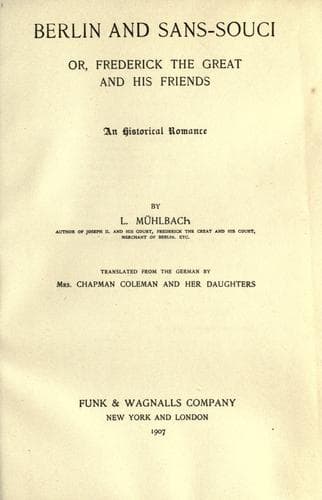
Berlin and Sans-Souci; Or, Frederick the Great and His FriendsMühlbach, L. (Luise)
History
Berlin and Sans-Souci; Or, Frederick the Great and His Friends
Mühlbach, L. (Luise)
Frederick II, King of Prussia, 1712-1786 -- Fiction; Prussia (Germany) -- History -- Frederick II, 1740-1786 -- Fiction
At this moment a wild cry of triumph was heard without; then curses
and loud laughter. The monks were bowed down before the host, and
did not seem to hear the tumult. They sang and prayed, and now the
outcry and noise of strife was hushed, and nothing was heard but the
faint and dying tones of the organ. The pandours had left the
cloister; they had found the adutant of the king and borne him off
as a rich spoil to their commander, Colonel von Trenck.
The soldiers were gone, it was therefore not necessary to continue
the worship of God. Tobias Stusche repeated a pater-noster, gave his
hand to the unknown abbot, and they turned to leave the church. As
they slowly and majestically swept through the aisles, the monks
bowed their heads in reverence; the organ breathed its last grand
accord, and the glorious sun threw a beckoning love-greeting through
the lofty windows of painted glass. It was a striking and solemn
scene, and the unknown abbot seemed strangely impressed. He paused
at the door and turned once more, and his glance wandered slowly
over the church.
One hour later the heavy state-coach of the Abbot of Clostenberg
rolled down from Camens. In the coach sat Tobias Stusche with the
unknown abbot. They took the road to Frankenstein. Not far from the
gate the carriage stopped, and to the amazement of the coachman, no
abbot, but a soldier clad in the well-known Prussian uniform,
descended. After leaving the coach, he turned again and bowed to the
worthy Abbot Stusche.
"I will never forget this bold and noble act of your excellency,"
said the king, giving his hand to the abbot. "You and your cloister
may at all times count upon my special favor. But for your aid, I
should this day have been betrayed into a most unworthy and shameful
imprisonment. The first rich abbey which is vacant I will give to
you, and then in all future time I will confirm the choice of abbot,
which the monks themselves shall make." [Footnote: In gratitude for
this service, the king gave the rich Abbey of Sentua to Stusche, and
kept up with him always the kindest intercourse. There are letters
still preserved written by the king himself to the abbot, filled
with expressions of heart-felt kindness and favor. Frederick sent
him from Meissen a beautiful set of porcelain, and splendid stuff
for pontifical robes, and rare champagne wine. While in Breslau, he
invited him twice to visit him. Soon after the close of the Seven
Years' War, Stusche died. The king sent a royal present to the
cloister with a request that on the birthday of the abbot a solemn
mass should be celebrated. Some years later, Frederick stopped at
Camens, and told the abbot to commission the first monk who died to
bear his loving greeting to the good Abbot Stusche in Paradise.--
(See Rodenbeck.)]
"O my God!" exclaimed the abbot, "how rarely must your majesty have
met with honest and faithful men, if you reward so richly a simple
and most natural act of love!"
Public-domain text, read in full here on John Shaqi.
Reviews
Reviews
No reviews yet
Be the first to share your thoughts on this work.
Elsewhere in the archive
Join the Discussion
Join the discussion
Sign in to leave a comment or review.
Sign InorCreate an account