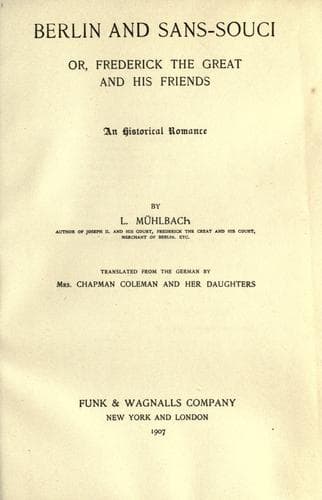
Berlin and Sans-Souci; Or, Frederick the Great and His FriendsMühlbach, L. (Luise)
History
Berlin and Sans-Souci; Or, Frederick the Great and His Friends
Mühlbach, L. (Luise)
Frederick II, King of Prussia, 1712-1786 -- Fiction; Prussia (Germany) -- History -- Frederick II, 1740-1786 -- Fiction
The king glanced backward at the noble steed, who, slender and
graceful and swift as a gazelle, was in a moment so far distant as
to be no larger than a flying eagle. He then advanced toward
Frankenstein: both were silent; neither gave another thought to the
gallant horse, who, riderless and guided by instinct alone, was far
on the way to Glatz. Once before they reached the city, the king
turned and fixed his eyes upon the open, youthful, and handsome face
of Trenck.
"I believe it would be better for you if this colonel of pandours
were not your relation," said the king thoughtfully; "there can no
good come to you from this source, but only evil."
Frederick von Trenck turned pale. "Does your majesty command that I
shall change my name?"
"No," said the king after a moment's reflection. "The name is a holy
inheritance which is handed down from our fathers, and it should not
be lightly cast away. But be careful, be careful in every
particular. Understand my words, and think upon my warning, Baron
von Trenck."
CHAPTER XIII.
THE LEVEE OF A DANCER.
In Behren Street, which was at that time one of the most recherche
and beautiful streets of Berlin, order and quiet generally reigned.
To-day, however, an extraordinary activity prevailed in this
aristocratic locality; splendid equipages and gallant riders,
followed by their attendants, dashed by; all seemed to have the same
object; all drew up before the large and elegant mansion which had
for some time been the centre of attraction to all the courtly
cavaliers of the Prussian capital. Some of the royal princes, the
young Duke of Wurtemberg, counts, ambassadors, and generals, were
to-day entreating an audience.
Who dwelt in this house? What distinguished person was honored by
all these marks of consideration? Why was every face thoughtful and
earnest? Was this a funeral, and was this general gloom the
expression of the heart's despair at the thought of the loved and
lost? Perhaps the case was not quite so hopeless. It might be that a
prince or other eminent person was dangerously ill! "It must be a
man," as no woman was seen in this grand cavalcade. But how account
for those rare and perfumed flowers? Does a man visit his sick
friend with bouquets of roses and violets and orange-blossoms? with
rare and costly southern fruits in baskets of gold and silver? This
would indeed be a strange custom!
Public-domain text, read in full here on John Shaqi.
Reviews
Reviews
No reviews yet
Be the first to share your thoughts on this work.
Elsewhere in the archive
Join the Discussion
Join the discussion
Sign in to leave a comment or review.
Sign InorCreate an account