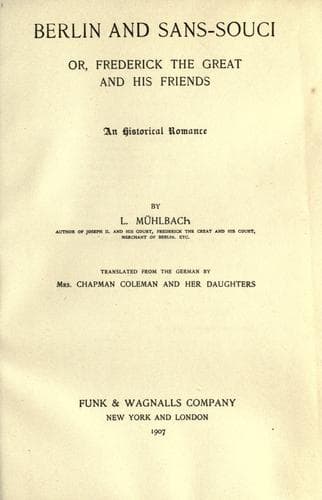
Berlin and Sans-Souci; Or, Frederick the Great and His FriendsMühlbach, L. (Luise)
History
Berlin and Sans-Souci; Or, Frederick the Great and His Friends
Mühlbach, L. (Luise)
Frederick II, King of Prussia, 1712-1786 -- Fiction; Prussia (Germany) -- History -- Frederick II, 1740-1786 -- Fiction
Frederick von Trenck remained in arrest till every preparation was
completed. The army was ready to march. The king assembled his
officers, and announced to them that they were bound once more to
Silesia to bloody battle, and, with God's help, to glorious victory.
On that day Frederick von Trenck was released from arrest. The king
received him with a gracious smile, and commanded him to remain near
him. Trenck's comrades envied him because of the royal favor;
because of the friendly smiles and gracious words which, more than
once during the day, the king directed to him. No one understood how
Trenck could remain sad and silent under all these evidences of
royal favor; no one understood how this gallant young officer could
enter upon this campaign with bowed head and heavy brow; he should
have sat upon his horse proud and erect--not dreaming, not lost in
melancholy musing.
No one but the king could comprehend this; his sympathetic soul was
touched by every emotion of his young officer, and he had pity for
every pang he inflicted. All this vast crowd of men had taken leave
of those they loved and cherished. Trenck alone had been denied this
solace. They had all received a love-greeting, a blessing, and a
last fond kiss--a last tear to encourage them in battle, perhaps in
death. Trenck had no kiss, no blessing, no farewell. He had said
farewell to fortune, to love and hope; and even now, though marching
to battle, perhaps to victory, he had no future. Tears were flowing
for him, and tears would be his only inheritance.
BOOK III.
CHAPTER I.
THE ACTORS IN HALLE.
His excellency, Gotshilf Augustus Franke, president of the
university at Halle, bore unmistakable marks of anger and excitement
upon his usually calm countenance, as, seated at his study-table, he
glanced from time to time at a paper spread out before him.
The entrance of two of his friends and colleagues seemed scarcely to
interrupt his disagreeable train of thought, as he bade them good
morning and thanked them for coming to him so promptly.
"I have requested your presence, my friends," he continued, "to
inform you of the receipt of the answer to the petition which we
presented to the General Directory."
"Ah, then," cried Professor Bierman, "our troubles are at an end!"
"Not so," said Professor Franke, gloomily; "the wishes of the
servants of the Lord do not always meet with the approbation of
kings. King Frederick the Second has refused our petition which was
presented to him by the General Directory."
"Refused it?" exclaimed the two professors.
"Yes, refused it; he declares that he will not allow the actors to
be expelled from Halle, until it can be satisfactorily proved that
they have occasioned public disturbances in our midst."
"This is unheard-of injustice," exclaimed Professor Bierman.
"It is a new proof of the king's utter godliness," said Professor
Heinrich. "He has already gone so far as to declare that these
actors shall receive Christian burial."
Public-domain text, read in full here on John Shaqi.
Reviews
Reviews
No reviews yet
Be the first to share your thoughts on this work.
Elsewhere in the archive
Join the Discussion
Join the discussion
Sign in to leave a comment or review.
Sign InorCreate an account