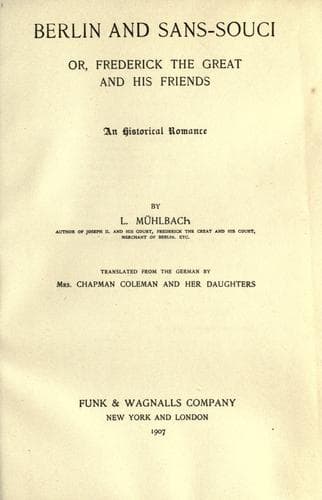
Berlin and Sans-Souci; Or, Frederick the Great and His FriendsMühlbach, L. (Luise)
History
Berlin and Sans-Souci; Or, Frederick the Great and His Friends
Mühlbach, L. (Luise)
Frederick II, King of Prussia, 1712-1786 -- Fiction; Prussia (Germany) -- History -- Frederick II, 1740-1786 -- Fiction
This unexpected result made the other professors falter in their
determination. Their temporal good depended very much on the
attendance of the students upon their lectures. They found that they
must consent to listen to Eckhof and his companions, if they would
be heard themselves; and, at length, they determined to make peace
with the students and actors, and to visit the theatre.
Peace was now proclaimed, and Eckhof, whose noble and tender heart
was filled with joy and gratitude, played "Britannicus" with such
power and feeling that he even won applause from the professors.
President Franke was still confined to his room. The terror of a
forced visit to the theatre, which would be known as an expiation
for his fault, made his nights sleepless and his days most wretched.
At length, however, the answer to the petition arrived, and, to his
great relief, he found himself condemned to pay a fine of twenty
thalers to the almshouse of Halle; and no further mention was made
of his visit to the theatre.
CHAPTER VI
THE BATTLE OF SOHR.
Deep silence reigned in the encampment which the Prussians had
established near the village of Sohr. The brave soldiers, wearied
with their long march, were sleeping quietly, although they knew
that the Austrian army, which far outnumbered their own, was
hastening toward them, and would attack them within a few hours.
This knowledge did not alarm them, they had not so soon forgotten
their signal victory over Karl von Lothringen, with his Austrians,
Bavarians, and Saxons, at Hohenfriedberg. They did not fear a defeat
at Sohr, although the grand duke was now the leader of forty
thousand men, and Frederick's army had been so diminished by the
forces he had sent to Saxony and Silesia, that it consisted of
scarcely twenty thousand men. The Prussian soldiers relied
confidently upon the good fortune and the strategic talent of their
king; they could sleep quietly, for Frederick watched beside them.
The watch-fires had died out, the lights in the tents of the
officers were extinguished. Now and then might be heard the measured
tread of a sentinel, or the loud breathing of some soldier dreaming
perhaps of his distant home or forsaken bride. No other sounds broke
upon the night air. The Prussian army slept. Alas! how many of them
were now dreaming their last earthly dream; how many on the morrow
would lie with gaping wounds upon a bloody battle ground, with
staring glassy eyes turned upward, and no one near to wipe the
death-drops from their brows! They know not, they care not, they are
lost in sleep. There can be no pressing danger, for the king is in
their midst--the light has been extinguished in his tent also. He
sleeps with his army.
Public-domain text, read in full here on John Shaqi.
Reviews
Reviews
No reviews yet
Be the first to share your thoughts on this work.
Elsewhere in the archive
Join the Discussion
Join the discussion
Sign in to leave a comment or review.
Sign InorCreate an account